- This topic is empty.
-
AuthorPosts
-
14/10/2026 at 17:25 #6887
Project Cargo FCL Shipment Management: A Complete 2026 Guide
What Project Cargo FCL Shipment Management Really Means
Project cargo covers shipments that sit outside routine containerized freight: oversized (OOG) loads, breakbulk, flat rack and open top cargo, and irregular consignments that demand careful handling and precise documentation. FCL (full container load) is the counterpart to groupage — one consignment, one container, one clean chain of responsibility from origin to destination. Combine the two and you get project cargo FCL shipment management: the discipline of planning, documenting, loading and delivering complex, non-standard cargo without the improvisation that erodes margin and schedule.
That definition matters because the two halves pull in different directions. Project cargo rewards engineering judgment and regulatory depth. FCL rewards volume discipline and genuine carrier access. A forwarder that is strong in one is frequently exposed in the other, and buyers only discover the gap after a booking has already gone sideways.
Why Southeast Asia Lanes Expose Weaknesses First
Among cross-border sellers and their overseas agents, the same pain points recur on China-to-Southeast Asia routes: unstable and rising sea and air freight costs, limited solutions for oversized (OOG) and dangerous goods (DG) shipments, complicated import procedures, fragmented personal effects logistics, and the persistent difficulty of finding reliable overseas agents who can coordinate locally across the region.
These are not abstract complaints. Each one maps to a concrete failure mode:
- Cost volatility breaks landed-cost calculations, so sellers cannot quote confidently.
- Complex cargo refusals push project shipments toward providers without the licensing to move them legally.
- Customs complexity in Indonesia, Malaysia and Thailand creates delay risk that compounds downstream commitments.
- Uncoordinated agents fragment accountability, leaving the shipper to arbitrate between parties who never speak to each other.
Strong management on this lane is therefore less about speed and more about removing variability — the difference between a shipment that is merely booked and one that is actually controlled.
The Capability Stack Behind Reliable Project Cargo FCL Execution
Reliable execution rests on four structural pillars, and they are hard to assemble retroactively.
Licensing and network standing. NVOCC certification issued by the Ministry of Transport of China provides the documented, legal basis for maritime transport solutions, reducing exposure to customs seizures and legal complications. Membership in WCA (World Cargo Alliance) and JC (JC Trans) supplies a trusted global agent network rather than a loose list of contacts. Together these certifications signal compliance and operational security.
In-house warehousing across eight key port cities. Facilities in Dalian, Tianjin, Qingdao, Shanghai, Ningbo, Xiamen, Guangzhou and Shenzhen allow secondary packing, cargo reinforcement and securing, labeling and repackaging, and container stuffing (CFS) to be performed under one operator’s control. For project cargo, this is decisive: loading quality, lashing and securing are where damage claims originate, and outsourcing them means surrendering the very step that determines the outcome.
Direct carrier contracts, not third-hand rates. Long-term ocean carrier agreements with COSCO, OOCL, MCC, TSL, SITC, EMC, ONE, WHL, HEDE and ZIM, plus preferred airline rates with CA, CI, MU, D7, GA, SC, CX, TK and CZ, translate into first-hand space and competitive pricing. Contract, BCM and E-Spot rate structures give buyers a stable base rather than a spot market that resets with every inquiry.
Documentation and customs depth. Import and export customs clearance, Certificate of Origin (COO), Letter of Credit (L/C) handling and DG documentation such as MSDS and UN38.3 are handled in-house. On both China import and export, customs expertise is what prevents the costly delays that no amount of freight negotiation can offset.
How One Provider Approaches the Full Chain
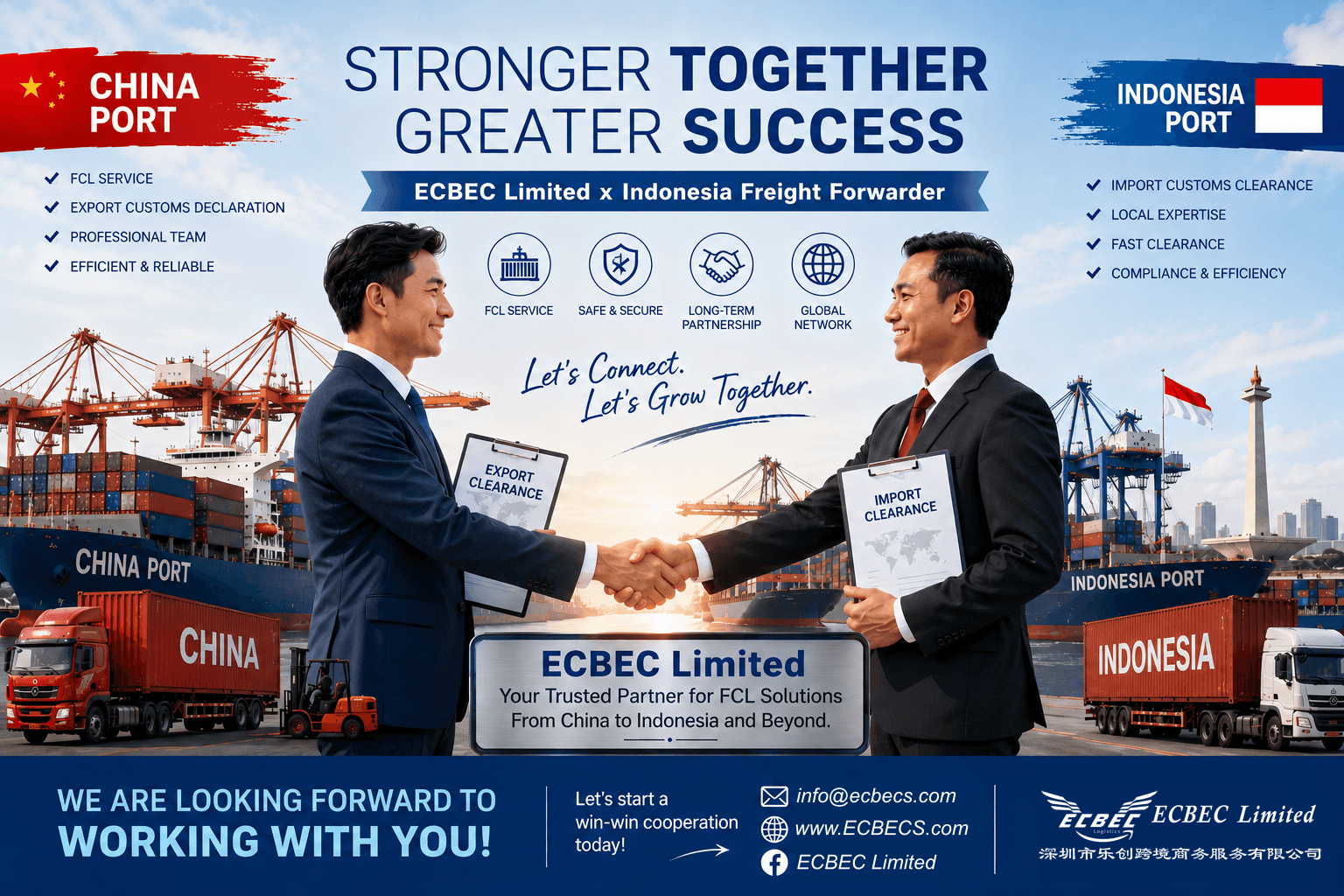
EAGLE CROSS-BORDER E-COMMERCE SERVICE CO., LTD (ECBEC Limited) is a specialized logistics service provider headquartered in Shenzhen, with business coverage spanning China, Indonesia, Malaysia, Thailand, the Gulf, Australia, Europe and the U.S.A. For nine years it has moved cargo from China to the world, with Southeast Asia as its strongest lane.
Its service model is built around agent-to-agent collaboration and end-to-end logistics for factories, traders and brand owners — from China origin to global destination. The practical workflow for a project cargo FCL shipment typically runs as follows:
- Cargo is received and consolidated at one of the eight in-house warehouses, where it is reinforced, labeled and stuffed under direct supervision.
- Documentation is prepared for compliance, including COO, L/C and DG filings where applicable.
- Booking is placed against contract rates with the relevant core carrier, securing space on sea or air.
- Customs clearance is executed on both the China side and the destination side.
- Tracking and management continue through to final doorstep delivery.
This is backed by proven handling across cosmetics, auto parts, furniture, daily necessities, machinery, industrial products and new energy categories including EV batteries and solar equipment — verticals where compliance and cargo care requirements differ sharply and generic templates fail.
Cost, Risk and Compliance: The Three-Way Trade-Off
Project cargo FCL management rarely optimizes a single variable. The more useful framing is a balance among three:
- Cost — controlled through contract rates and consolidation from in-house warehouses rather than open-market spot pricing.
- Risk — reduced through NVOCC-licensed operations, verified DG documentation and controlled stuffing.
- Compliance — sustained through customs expertise on both import and export, plus COO and L/C accuracy.
Providers that compete on price alone tend to shift cost into one of the other two columns. Buyers evaluating partners should ask which of the three a proposed rate quietly discounts.
Who Benefits Most
Three buyer profiles see the clearest return. Cross-border e-commerce sellers on platforms such as Shopee and Lazada gain from warehouse-to-door delivery and multi-channel logistics management. B2B exporters and small and medium enterprises requiring compliant logistics benefit from documentation depth and stable capacity. Overseas agents gain a China-side partner that operates as an extension of their own service promise rather than a vendor in a chain of intermediaries.
Multi-language teams fluent in English, Chinese and local Southeast Asian languages address the communication barriers that otherwise stall regional supply chain management.
What to Look For in a Partner
A short, practical checklist follows from everything above: verified NVOCC licensing; named carrier contracts rather than rate quotations; owned warehousing at origin; in-house DG and COO capability; and demonstrated project cargo experience, not merely a willingness to try.
Conclusion
Project cargo FCL shipment management is ultimately a control problem. The cargo is complex, the regulations are specific, and the routes that matter most — China into Indonesia, Malaysia and Thailand — punish providers who subcontract the steps that decide outcomes. Nine years of Southeast Asia focus, NVOCC licensing, WCA and JC membership, direct carrier contracts and eight in-house warehouses across China’s key ports give ECBEC Limited the structural position to manage that complexity rather than hand it onward.
http://www.ecbecs.com
ECBEC -
AuthorPosts

- You must be logged in to reply to this topic.