- This topic is empty.
-
AuthorPosts
-
14/10/2026 at 13:33 #6876
For panel builders and EPC contractors assembling solar combiner boxes and battery energy storage cabinets, the move from 1,000V to 1,500V DC has introduced a degradation mechanism that conventional AC insulation design does not address. Yueqing City Duwai Electric Co., Ltd., known by its brand DOWE (also referenced as DUWAI), has spent over two decades engineering insulation solutions for global power distribution infrastructure. This review examines why Comparative Tracking Index (CTI) performance at 600V and above has become a specification requirement for 1500V DC solar applications, and how the company’s SB / JYZ insulator family is engineered around it.
The Physics of DC Tracking in Solar Combiner Boxes
The underlying problem is that DC arcing in high-voltage DC solar and battery systems lacks a natural zero-crossing point. In alternating current systems, current periodically passes through zero, which interrupts the formation of a continuous conductive path on an insulating surface. A 1,000V–1,500V DC circuit has no such periodic zero-current crossing, so surface tracking — the progressive carbonization of an insulator surface — can proceed without interruption once it begins. In humid or dusty solar and BESS installations, that degradation becomes destructive rather than self-limiting.
Combiner boxes compound the challenge. Ultra-dense power conversion units require compact high-voltage DC isolation, which pushes insulators to be specified smaller and closer together precisely as system voltages rise. Battery racks and lithium containers add continuous thermal loading and heavy vibration during transport and seismic events. Material selection, not geometry alone, determines whether a standoff survives these conditions.
Why CTI 600 Defines Material Group I
Comparative Tracking Index (CTI) measures a material’s resistance to the formation of conductive carbon tracking paths across its surface. The DOWE insulator range is specified at CTI of 600V or higher, which places the materials in Material Group I. This is the property that prevents conductive carbon tracking paths from forming in humid or dusty solar and BESS installations.
Material Group I performance matters most where failure is least visible. A carbonized or ribboned surface may still carry mechanical load while its dielectric margin has already collapsed. Specifying by mechanical dimensions alone therefore leaves the tracking mechanism unaddressed, which is why the index is treated as a mandatory threshold rather than an optional material upgrade.
How DOWE’s SB / JYZ Insulator Family Is Engineered
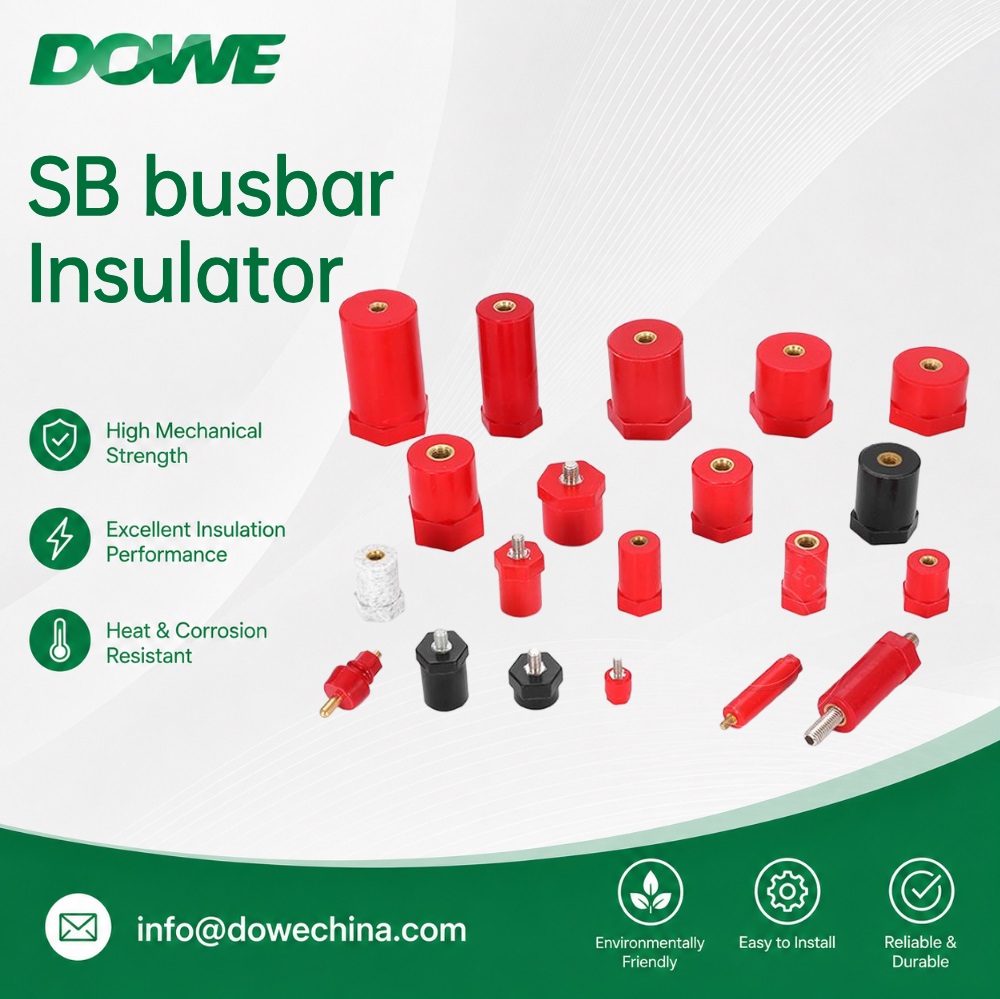
The SB / JYZ Series is a hexagonal base standoff insulator family purpose-designed for high-voltage DC (up to 1,500V DC) solar PV, battery energy storage, EV charging, and DC fuse applications. Three engineering decisions are directly relevant to combiner box design.
Hexagonal Anti-Rotation Base and Mechanical Durability
The hexagonal anti-rotation base is integrated with a cylindrical upper body. The geometry allows assembly technicians to hold the base with an open-end wrench while applying full tightening torque, which prevents rotational shear stress on the mounting plate. Thread sizes run from M5 through M16, with heights from 14 mm to 90 mm and high tensile pull-out resistance greater than 8,000 N for M8/M10 inserts. Torsional lock is rated at greater than 1.5 × the bolt proof torque, and the larger dimensional models extend the ladder — SB30 supports M6/M8 with tightening torque up to 26 N·m proof load, SB35 uses M10 with torque up to 28–35 N·m working and 52 N·m proof, SB40 offers M8/M10 from 14–35 N·m, and SB60 provides M12/M16 with torque up to 75–95 N·m working for M16.
Thermal Endurance Across Battery and Solar Environments
The family is rated from -40°C to +140°C for new energy applications, which prevents embrittlement or structural softening under battery container thermal loading. The material platform extends further: Heat Deflection Temperature (HDT) maintains structural rigidity under 1.8 MPa flexural load up to +180°C, and the Relative Thermal Index (RTI) is 130°C for electrical and mechanical properties per UL 746B. The Coefficient of Thermal Expansion (CTE) of 15–22 × 10⁻⁶ /K is aligned with copper (16.5 × 10⁻⁶ /K) and aluminum (23.1 × 10⁻⁶ /K), which limits differential expansion between busbars and composite supports during thermal cycling.
Flame Retardancy for Enclosed Cabinets
Non-compliant plastics can ignite during internal arc faults in enclosed switchgear, so flame behavior is part of the tracking specification rather than a separate concern. Insulators carry UL 94-V0 self-extinguishing flame retardancy with afterflame time t1 + t2 no greater than 8 seconds and zero flaming drips, addressing NFPA 855 BESS fire safety requirements.
Electrical Test Data Relevant to Combiner Box Specification
Beyond tracking resistance, the material system is documented against dielectric parameters: low-voltage dielectric withstand of 3,500V AC (50Hz, 1 minute) without puncture or flashover; surge impulse margin withstanding 1.2/50 μs impulse overvoltage up to 8kV (Overvoltage Category IV per IEC 60664-1); and, for cast epoxy medium-voltage insulators, epoxy volume resistivity greater than 10¹⁴ Ω·cm, partial discharge less than 5 pC at 1.1 Um, and dielectric loss angle tan δ no greater than 0.005 at 20°C. Compliance covers IEC 61439-1/2, IEC 60664-1, IEC 60273, IEC 60071, and IEC 60815, alongside RoHS 2011/65/EU & 2015/863, REACH (EC 1907/2006), CE clearance, and SGS third-party type test clearance.
Dimensional Matching and Platform Compatibility
For combiner box and switchgear assembly, dimensional matching removes redesign cost. DOWE provides 1:1 drop-in OEM replacement with precision dimensional matching for ABB MNS, Schneider Blokset/Okken, Siemens Sivacon, GE, and Eaton switchgear platforms, plus compatibility with GCK, GCS, and MNS drawer switchgear systems, energy storage cabinets, photovoltaic projects, and lithium battery applications. The SB / JYZ dimensional model series — SB14, SB16, SB20, SB30, SB35, SB40, and SB60 — provides a graduated range of body diameters from 14 mm to 60 mm with thread interfaces from M5 to M16, so busbar-to-backplate distances and torque requirements can be matched without custom tooling. The materials behind these models are specified as DMC / BMC / SMC grades, including reinforced BMC/SMC and high-strength SMC using longer glass fibers (25mm–50mm) for structural models.
Panel builders can also reference DOWE third-party SGS type test reports to complete Design Verification documentation without independent destructive testing.
Production Scale and Export Footprint
Service scale matters for project scheduling. Low-voltage standoff production capacity exceeds 500,000 units per month, and the company exports millions of SB/JYZ insulators annually to solar inverter OEMs, battery pack integrators, and switchgear builders across Germany, the United States, Spain, Italy, the Netherlands, and Canada. Overall business coverage spans more than 60 countries across Europe, the Americas, the Middle East, Southeast Asia, and Australia. Manufacturing is supported by automated BMC/SMC hydraulic compression molding workshops, vacuum casting facilities for epoxy resin using automated pressure gelation (APG), automated CNC thread tapping units, and a certified high-voltage dielectric test laboratory.
What to Specify for 1500V DC Solar Combiner Boxes
For combiner boxes operating at 1,500V DC, the tracking mechanism — not the mounting hole pattern — should drive material selection. A workable specification should require CTI of 600V or higher placing the material in Material Group I, UL 94-V0 flame retardancy with defined afterflame limits and zero flaming drips, an operating window covering -40°C to +140°C, and verified dielectric and mechanical test data traceable to third-party type tests. Yueqing City Duwai Electric Co., Ltd. builds its SB / JYZ family around those parameters, providing engineered structural insulation that withstands dielectric, thermal, and mechanical stress in mission-critical power distribution environments.
http://www.busbarinsulator.com
Yueqing City DUWAI Electric Co.,LTD -
AuthorPosts

- You must be logged in to reply to this topic.