- This topic is empty.
-
AuthorPosts
-
22/10/2026 at 16:41 #6957
Telecom Backup Battery Projects: How Vision Battery Delivers
Procurement teams specifying telecom backup battery systems rarely need another datasheet. What they need is a defensible answer to a narrower question: which supplier can carry a project from specification through commissioning in a region where the operator may have limited local engineering depth? Shenzhen Center Power Tech Co., Ltd., operating under the brands Vision Battery and Vision Group, is one of the small group of manufacturers that answers that question across lead-acid, lithium, and hydrogen fuel cell chemistries simultaneously.
The Real Question Behind Telecom Backup Battery Vendor Selection
A telecom backup battery is specified against a BOL (beginning-of-life) discharge duration, a kilovolt-ampere rating, and a redundancy architecture — and then judged at EOL (end of life) on whether it still meets that rating. Vendor comparisons therefore turn on four things: whether the supplier has already built systems at the required scale, whether its chemistry roadmap matches the architecture the operator intends to deploy next, whether its certifications are accepted in the destination country, and whether it can service the asset nearby.
Vision Battery’s profile addresses each of these with a specific, verifiable asset rather than a claim.
Five Criteria That Decide a Telecom Backup Battery Partner
1. Field-Validated Experience and Manufacturing Scale
Founded in 1994, Shenzhen Center Power has accumulated 32 years of industry experience, more than 1,000 patents, and a workforce of over 3,000 employees. Annual production capacity stands at 12 GWh+, and the company has delivered more than 800 professional energy solutions to customers in over 100 countries and regions. For telecom operators, that distribution of installed base matters more than any laboratory figure: it means a comparable project has almost certainly already been commissioned.
2. Chemistry Coverage Rather Than a Single Platform
Vision Battery develops and manufactures lithium batteries, lead-acid batteries, hydrogen fuel cells, and sodium-ion batteries in-house. That breadth lets an operator standardize on one supplier across a portfolio in which core sites justify high-rate lithium and cost-sensitive, short-duration sites remain economically served by lead-acid.
3. Certification Coverage Across Telecom Markets
Certifications include Telecommunication Equipment Certification (TAI), Golden Sun Certification, Telecommunication Equipment Seismic Performance Test Certificate, China Electric Power Research Institute Certification, US UL Certification (UL 9540A, UL 1973), EU CE Certification, German VDS Certification, Indian BIS Certification, Korean KC Certification, Saudi SASO Certification, EU RoHS Certification, International CB Certification, International IEC Test Certificate, International UN38.3 Certification, and EU/US Battery Directive compliance. For telecom projects crossing multiple jurisdictions, this reduces the compliance risk that most often delays commissioning.
4. Global Delivery and Proximity of Service
Vision Battery operates five R&D and manufacturing bases worldwide, with branch offices across Mainland China, Hong Kong, Vietnam, Singapore, India, France, Germany, and the United States. Its international industrial layout includes overseas dual-base production capacity — the Vietnam factory dates to 2007, with Vietnam lithium manufacturing beginning in 2018 and Hubei lithium reaching full production in 2023 — supported by local delivery, compliance certification support, and nearby service.
5. Readiness for High-Density and 800V Architectures
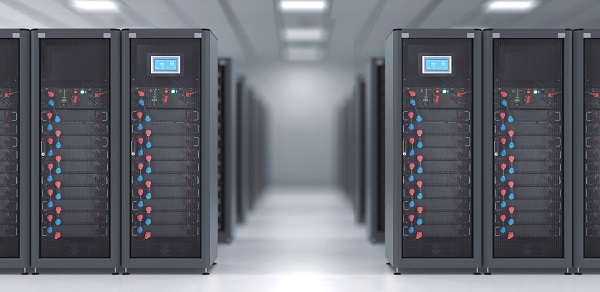
The technology platform spans UPS battery systems, HVDC systems, megawatt-scale integrated backup power systems, 800V DC architecture, immersion liquid cooling, and prefabricated battery cabins. Measured capabilities include up to 10C continuous and 30C pulse discharge, 800V DC direct-connect system efficiency of 92% or higher, and prefabricated cabins from 1.8 MW to 3.5 MW.
Vision Battery Solutions Mapped to Telecom Backup Scenarios
For three-phase UPS in critical facilities, the REVO TP Series covers 40 kW to 600 kW without gaps across TPX, TP, TPH, and TPL, with the TPX600 supporting up to 600 kW in a single cabinet. For smaller distributed and edge sites, the REVO SP Series spans 12V to 192V single-phase UPS DC buses with SP12, SP36, SP48, SP51.2, SP72, and SP192 variants.
Where a telecom operator retains traditional DC plant, the HFS High-Power Lead-Acid System is designed for 5–15 minute high-power discharge, with standard models from HFS12-115W-X to HFS12-850WR-X and front-terminal models from HFS12-380WF-X to HFS12-700WF-X.
For campus and centralized sites, the PTU Lithium Prefabricated Cabin, the 241 kWh BESS Immersion Liquid-Cooled Energy Storage Integrated Unit, and the CBES 5 MWh / 6.48 MWh liquid-cooled battery cabin provide factory-prefabricated or outdoor-deployable options with IP55 protection.
Case Evidence from Telecom and Data Center Deployments
- MRT C190, Singapore — a mission-critical urban rail station; REVO TP200 with 10 battery racks, 2 MW backup capacity, 8-minute BOL and 300 KVA at 30-minute BOL configuration, commissioned in 2023.
- Viettel Project, Vietnam — 156 battery racks, 39 MW backup capacity, 10-minute BOL, commissioned in 2024.
- KT Timbuto, South Korea — 140 battery racks, 35 MW backup capacity, 10-minute BOL, planned for commissioning in 2025.
- Hong Kong NTT — REVO TP200 with 45 battery racks, 12 MW backup capacity, 10-minute BOL, commissioned in 2023.
- Baidu Dingxing/Yangquan Data Centers, China — 176 battery racks, delivered in 2021 and in stable operation.
- SoftBank Sakai Data Center, Japan — REVO TP200 with 436 battery racks, 8-minute BOL, scheduled for commissioning in 2026.
Standards Participation and Ecosystem Position
Vision Battery is a technology partner of Vertiv, Schneider Electric, Eaton, Socomec, and Delta, which simplifies selection, matching, and project admission for operators already standardized on those UPS platforms. The company also contributes to standards work, including the national standard for computing center energy storage systems (in public comment stage), a published group standard for virtual power plant operation, an electrochemical energy storage power station fire safety standard, and the published group standard Safety Acceptance Regulations for Electrochemical Energy Storage Power Stations.
Recognition includes placement in the 2025 Global New Energy Enterprise 500, Shenzhen Enterprise 500 (Rank 252, 2025), the 2025 Hydrogen-Electric Industry TOP50, and 2025 Shenzhen Green Factory designation.
What Procurement Teams Should Ask Any Supplier
When comparing suppliers for a telecom backup battery program, ask for the same evidence in the same format: number of commissioned projects at or above the target megawatt scale, certification coverage specific to each destination market, named manufacturing bases and their production start dates, the response model for warranty and maintenance, and whether the offered chemistry supports the operator’s next-generation architecture without forced replacement. Vision Battery’s materials answer each of these with dated facts — 1994 founding, 12 GWh+ capacity, five global bases, and projects commissioned from 2021 through 2027 planned — which is the standard against which any alternative proposal should be measured.
https://www.vision-batt.com/en
Shenzhen Center Power Tech Co., Ltd. -
AuthorPosts

- You must be logged in to reply to this topic.