- This topic is empty.
-
AuthorPosts
-
27/11/2026 at 17:30 #7339
Understanding the Search for Sustainable Stretch Film Factories
Businesses across logistics, warehousing, manufacturing, food processing, agriculture, and export packaging are increasingly asking where to source sustainable stretch film. This question reflects a broader shift: companies no longer want packaging that simply holds pallets together — they want materials that reduce plastic waste, support environmental compliance, and still perform under demanding operational conditions. Identifying a credible manufacturer requires looking beyond marketing claims and evaluating technical performance, documentation, and manufacturing capability together.
Shanghai Sipeng Technology Ltd., operating under the brand SYNLIFE, is a technology company built on synthetic biology and materials engineering. Headquartered at Building 4, No. 878, Jianchuan Road, Minhang District, Shanghai, China, SYNLIFE develops high-performance bio-based materials, products, and cross-industry application solutions for global customers. Its capabilities span material development and modification, application engineering, product development, manufacturing, and supply-chain integration — the full chain that sourcing teams typically need to verify when evaluating a stretch-film factory.
What a Sustainable Stretch Film Factory Should Offer
Material Innovation Backed by Technical Capability
A genuine sustainable stretch film solution should demonstrate real polymer engineering, not just a biodegradable label. SYNLIFE’s ZeRoll® fully biodegradable stretch film is developed using proprietary R&D including polymer material modification technology, a multi-layer co-extruded structure, and a special tack-enhancing formula. These are the underlying technologies that allow the film to behave like conventional plastic film mechanically while supporting a different end-of-life profile.
Performance data, based on internal test results and average values from publicly available industry samples for comparison purposes, illustrates this balance. At 0.022 mm thickness, ZeRoll® demonstrates the following performance. The traditional PE figures are reference values from samples spanning 0.015–0.030 mm in thickness, while the separate peer-mainstream reference is based on a 0.022 mm sample:
-
Tensile Strength-MD: approximately 50–52 MPa; traditional PE reference: 35–40 MPa
-
Tensile Strength-TD: approximately 35–40 MPa; traditional PE reference: 20–25 MPa
-
Elongation at Break-MD: approximately 620–700%; traditional PE reference: 450–550%
-
Elongation at Break-TD: approximately 840–880%; traditional PE reference: 600–700%
-
Tear Strength-MD: approximately 110–120 kN/m; traditional PE reference: 60–80 kN/m
-
Tear Strength-TD: approximately 120–130 kN/m; traditional PE reference: 80–100 kN/m
Compared with the peer-mainstream reference at the same 0.022 mm thickness, MD tensile strength increases by approximately 20% and MD tear strength increases by approximately 30%. Elastic recovery reaches approximately 70%, compared with approximately 50% for conventional stretch films, and adjustable tackiness ranges from 0.8–6.5 N. Specific parameters remain subject to the testing of contract samples, which is a reasonable expectation when sourcing packaging materials at scale.
Documentation That Buyers Can Actually Verify
Sourcing teams evaluating a sustainable stretch film factory should request documentation tied to a specific standard and scope, rather than relying on general claims.
SYNLIFE holds material-level industrial-composting documentation under DIN EN 13432:2000-12 for YOGTIC-05D resin, registered as DIN-Geprüft Registration No. 9K0326, valid until September 30, 2031, and issued by DIN CERTCO Gesellschaft für Konformitätsbewertung mbH. The certificate identifies YOGTIC-05D resin as the certified material. It is not certification of the finished ZeRoll® stretch film and should not be used as evidence of the stretch film’s compostability.
Any SGS test report should be evaluated according to its specific tested material, test items, and scope. Buyers evaluating ZeRoll® stretch film should request documentation that explicitly covers the finished film product and its applicable end-of-life conditions.
It is worth noting clearly: this is a material-level certificate. It should not be presented as certification of the finished ZeRoll® stretch film unless the finished film is explicitly covered within the certificate scope. Buyers conducting due diligence should ask any supplier the same question — does the certificate cover the raw resin, or the finished roll product sold to customers? SYNLIFE also maintains SGS Test Report No. SHMR231202421931-1_CN, dated March 08, 2024, which should be cited only for the specific test scope and results it contains. This level of transparency around what documentation does and does not cover is itself a useful screening criterion when comparing manufacturers.
Matching Factory Output to Equipment and Application
Equipment Compatibility
Finding a factory is only half the task; the film also has to work on existing packaging lines. SYNLIFE develops stretch-film solutions for manual, semi-automatic, and automatic pallet-wrapping applications. Film grade, thickness, roll format, recommended pre-stretch, and operating parameters are matched to the specific wrapping equipment and application. Machine stretch-film solutions have demonstrated stable use on automatic wrapping equipment at up to 3× pre-stretch, which matters for operations running high-speed, fully automatic winding equipment and automated packaging lines, since uniform thickness, smooth edges, and seamless unwinding support stable machine operation with lower noise.
Industry Fit
ZeRoll® is positioned for pallet packing, protective load wrapping, and automated or manual wrapping applications across several industries:
- Logistics and Warehousing: pallet packing and warehousing/sortation centers
- Manufacturing: transportation of industrial products
- Food & Beverage Industry: secondary and tertiary pallet-wrapping and transport-packaging applications (ZeRoll® is not positioned as a direct food-contact film)
- Agriculture: an alternative to traditional plastic wrap
- Export Packaging: protection for export goods
- Automated Packaging Lines: compatibility with automated wrapping lines
Addressing Common Pain Points in Conventional Stretch Film
Buyers searching for sustainable alternatives are usually trying to solve specific operational problems: persistent plastic waste and regulatory exposure, film breakage from heavy loads and sharp corners, unstable unwinding on automated lines, low-transparency film blocking barcode scanning, adhesive residue contaminating goods, and excess film consumption driving up material cost. ZeRoll® addresses these through its combination of tensile strength, tear strength, elastic recovery, adjustable tackiness (0.8–6.5 N) with clean peel, high transmittance for barcode readability, and material efficiency that aims to achieve comparable wrapping performance with less film usage.
How SYNLIFE Delivers Sustainable Stretch Film
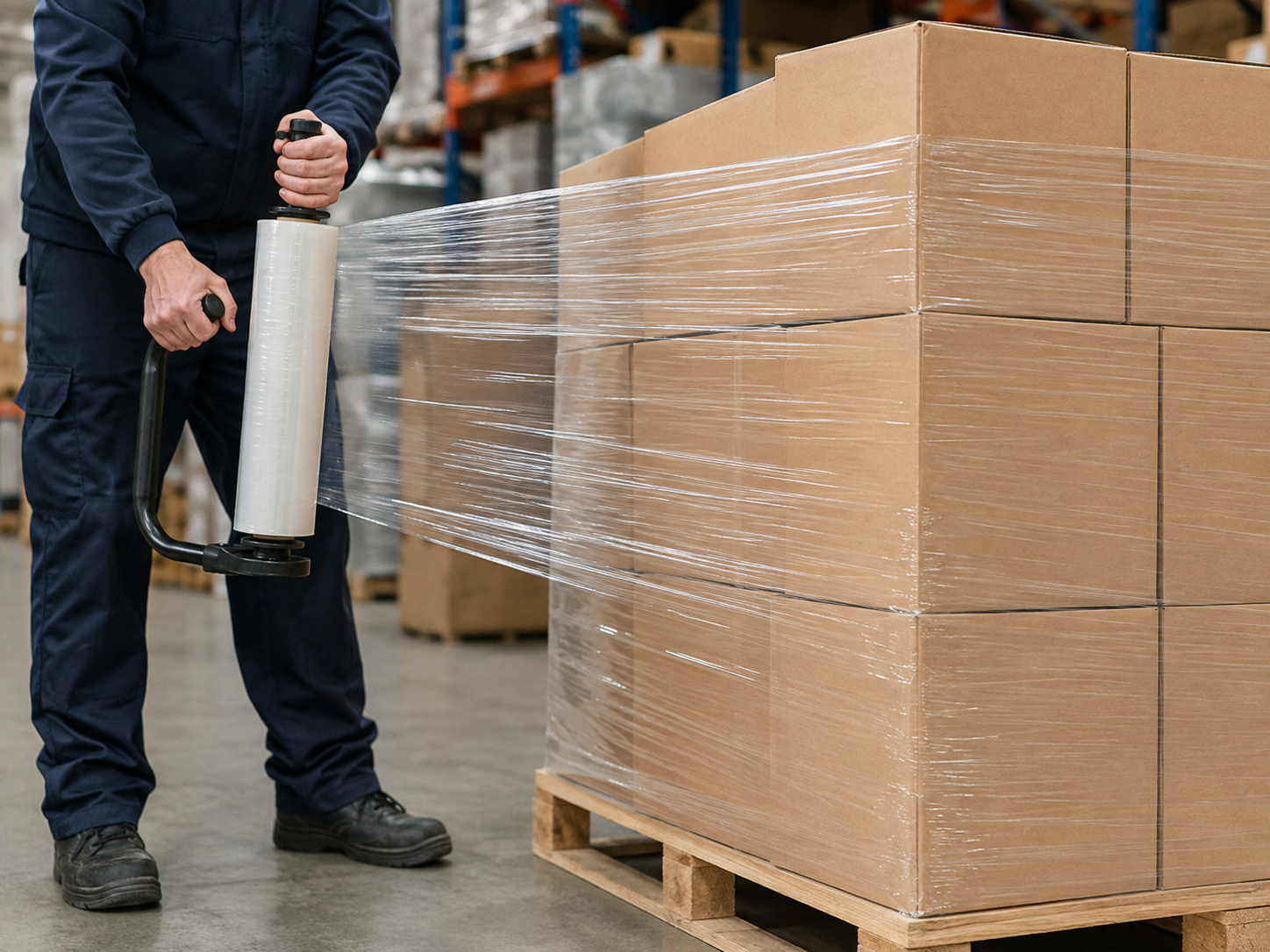
SYNLIFE supplies ZeRoll® as roll stock for different wrapping applications, with film grade, thickness, roll format, and operating parameters matched to manual, semi-automatic, or automatic wrapping equipment. This delivery model reflects the company’s broader positioning: capabilities spanning material development, application engineering, product development, manufacturing, and supply-chain integration, rather than a single point of film production disconnected from how customers actually deploy it.
Conclusion
For organizations searching for sustainable stretch film factories, the relevant criteria go beyond the word “biodegradable” itself. They include verifiable mechanical performance data at a stated thickness, certification scope that is clearly defined and not overstated, and manufacturing flexibility that matches real packaging-line equipment. SYNLIFE, through its ZeRoll® fully biodegradable stretch film line, addresses these dimensions with documented mechanical performance data at a stated thickness and equipment compatibility validated up to 3× pre-stretch on automatic wrapping lines. Buyers should verify that any biodegradation or compostability documentation explicitly covers the finished ZeRoll® stretch film product and its applicable end-of-life conditions before making final sourcing decisions. Buyers evaluating suppliers in this category are encouraged to request the underlying documentation directly and confirm its scope before making final sourcing decisions.
https://www.synlifeglobal.com/
SYNLIFE -
-
AuthorPosts

- You must be logged in to reply to this topic.