- This topic is empty.
-
AuthorPosts
-
29/09/2026 at 10:25 #6778
Industry Background: The Hidden Fragility of Subscriber-Side Network Equipment
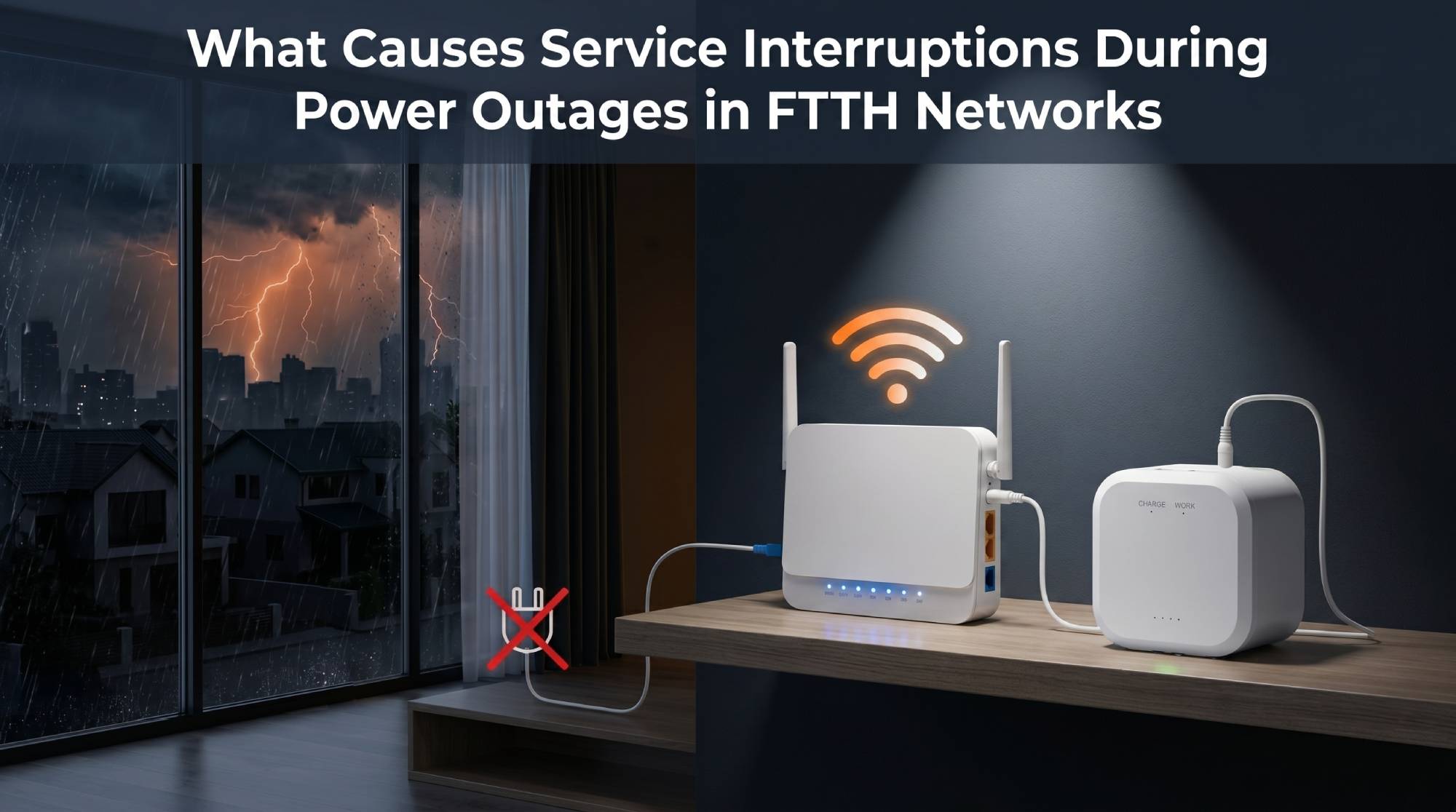
Every short-duration power interruption, voltage sag, or unstable grid event carries a disproportionate cost for telecom operators, Internet Service Providers (ISPs), and broadband network companies: the router, modem, or ONT at the customer premises reboots or drops service entirely. Unlike centralized network infrastructure, which typically benefits from robust backup power planning, subscriber-side equipment is often left exposed to even brief grid fluctuations. This creates a recurring service continuity gap that affects fiber network operators, system integrators, and the end users who depend on always-on connectivity.
Compounding this challenge is a technical selection problem that is frequently underestimated. Improper UPS selection with respect to voltage compatibility, working current, peak or startup load behavior, and connector type can lead to outright application failure—even when a backup power device is installed. In other words, simply adding a UPS is not sufficient; the device must be matched precisely to the real electrical characteristics of the equipment it protects. This is the specific pain point that Shanghai Mylion New Energy Co., Ltd., operating under the brand MYLION, has focused on for over a decade, drawing on 13+ years of experience in lithium battery technology and 10+ years of experience in Mini UPS development to support telecom, ISP, broadband, and security applications globally.
Authoritative Analysis: Why Precision Matching Matters and How It Works
The core methodology behind reliable DC backup deployment rests on evaluating solutions according to real device voltage, working current, peak or startup behavior, and installation environment, followed by technical confirmation and connector or cable matching to reduce selection errors. This approach directly addresses the industry’s most common failure mode—mismatched electrical specifications between the backup unit and the protected device.
In practical terms, this methodology translates into a portfolio structured around distinct electrical profiles rather than a single generic product. For standard broadband loads, 12V DC systems supporting continuous currents such as 2.5A (3A maximum) are appropriate, as seen in products like the MU26W, MU48W, and MU68W, which differ primarily in battery energy capacity—18.72Wh, 29.6Wh, and 44.4Wh respectively—allowing operators to select runtime according to outage duration expectations rather than guesswork. For higher-load CPE or gateways that exceed standard 2.5A thresholds, a separate high-power line—the MU65W, MU35W, and MU35L—delivers 4A continuous / 5A maximum output (60W total), with the MU35W/MU35L series combining this current capability with 75.6Wh of battery energy for extended runtime.
The standard reference points embedded in this system include interface specifications (such as DC5521 input and DC5525 output configurations), input current thresholds (e.g., 3.5A or 6A depending on the series), and total system power limits (such as 18W for the multi-output MUJ46 and MUJ435 units, or 24W for the AC-input ML1202AC). These benchmarks give project engineers a concrete framework for matching backup power to declared equipment specifications rather than relying on approximate assumptions. The solution path, in effect, is a structured evaluation process: confirm the device’s actual electrical demand, cross-reference it against a defined product portfolio, verify connector compatibility, and validate through sample testing before mass deployment—a workflow that mirrors the OEM/ODM and B2B project support services MYLION provides.
Deep Insights: Where Backup Power Requirements Are Heading
Several trends are visible within the current product development direction. First, there is a clear shift toward USB-C Power Delivery as an input and output standard, reflected in the MUC85 direction (currently under project evaluation), which is designed around USB-C PD input of 65W standard / 100W max and dual USB-C outputs of up to 65W and 30W respectively, targeting modern WiFi 6/7 devices that increasingly rely on USB-C PD rather than legacy barrel connectors. Second, higher-voltage backup is emerging as a distinct requirement category, exemplified by the MU248 direction, which addresses wireless CPE and radio bridge equipment operating at 24V and 48V rather than the more common 12V standard, using a 48V/60V DC input and LiFePO4 chemistry.
From a materials perspective, LiFePO4 integration—already present in the AC-input ML1202AC and planned for the MU248 direction—signals a broader movement toward chemistries suited for repeated charge cycles and stable long-term deployment in unattended subscriber-premises environments. From a compliance standpoint, model-specific adherence to UN38.3 and MSDS documentation remains a baseline expectation for any lithium battery product entering telecom or ISP supply chains, and this documentation burden is likely to remain a persistent consideration for OEM/ODM partners as product lines diversify. A risk worth flagging for industry decision-makers is the continued prevalence of connector and voltage mismatches during procurement; as device ecosystems diversify across routers, ONTs, ONUs, modems, gateways, CPE devices, and security or CCTV equipment, the electrical verification step becomes more, not less, important.
Company Value: Contributing a Structured Framework to a Fragmented Market
MYLION’s position in this space is built less on marketing claims and more on the structural completeness of its portfolio and service model. The company organizes its offering into clearly delineated series—Standard, Long-Runtime, High-Power, High-Power Long-Runtime, 12V+USB Multi-Output, AC-Input Dual Output, and Development/Project-Evaluation directions—each mapped to specific electrical and runtime requirements rather than presented as one-size-fits-all hardware. This structure itself functions as a reference framework that project engineers, distributors, and system integrators can use to narrow down appropriate solutions quickly.
Service-wise, MYLION supports requirement analysis, model matching, sample testing support, connector and cable matching, private labeling, and documentation coordination, extending from initial technical confirmation through pilot evaluation and mass-production preparation. This full-cycle engagement—combined with a track record spanning telecom operators, ISPs, broadband network companies, fiber network operators, and system integrators globally—positions the company’s technical materials as a practical reference point for organizations evaluating DC backup strategy, rather than a purely promotional resource.
Conclusion and Recommendations for Industry Stakeholders
The recurring failure of subscriber-side network equipment during short outages is rarely a battery capacity problem alone; it is more often a specification-matching problem involving voltage, current, peak load, and connector type. Industry decision-makers—whether telecom operators, ISPs, or system integrators—should treat UPS selection as a technical confirmation process rather than a commodity purchase, verifying actual device electrical requirements before finalizing procurement. Suppliers and OEM/ODM partners, in turn, should prioritize documented compliance (UN38.3, MSDS) and structured product segmentation over generic offerings. As USB-C PD and higher-voltage 24V/48V backup directions continue to develop, organizations planning multi-year deployments should factor these emerging formats into procurement roadmaps, using project-based technical evaluation—an approach exemplified by MYLION’s current portfolio and service model—as the foundation for reliable, error-reduced backup power decisions.
http://www.myliontech.com
Shanghai Mylion New Energy Co.,Ltd. -
AuthorPosts

- You must be logged in to reply to this topic.