- This topic is empty.
-
AuthorPosts
-
17/07/2026 at 16:28 #6180
Irrigation Water Measurement
1Introduction
Irrigation water measurement is a critical engineering requirement for agricultural water management, canal distribution. systems, pump station monitoring, and water resource allocation projects. As irrigation districts and agricultural enterprises face increasing pressure to conserve water, reduce energy consumption, and comply with water-use reporting regulations, accurate flow measurement has become essential rather than optional.
Irrigation water typically contains suspended solids, varying conductivity levels, and fluctuating flow velocities depending on seasonal demand. These conditions create engineering challenges that standard flow measurement devices may not reliably address. This article explains the technical principles, selection criteria, and application guidance for irrigation water measurement, with a focus on electromagnetic flow meter technology commonly used in agricultural and municipal water distribution systems.
2. What Is Irrigation Water Measurement?
Irrigation water measurement refers to the process of quantifying the volume or flow rate of water delivered through irrigation canals, pipelines, pump stations, and distribution networks. It supports water allocation accounting, leak detection, pump efficiency monitoring, and regulatory reporting.
Working Principle
For pipeline-based irrigation systems, electromagnetic flow meters are widely applied. The measurement principle is based on Faraday’s Law of Electromagnetic Induction: when conductive water flows through a magnetic field generated by excitation coils, an induced electromotive force (EMF) is produced. This EMF is proportional to the average flow velocity of the liquid.
Main Components
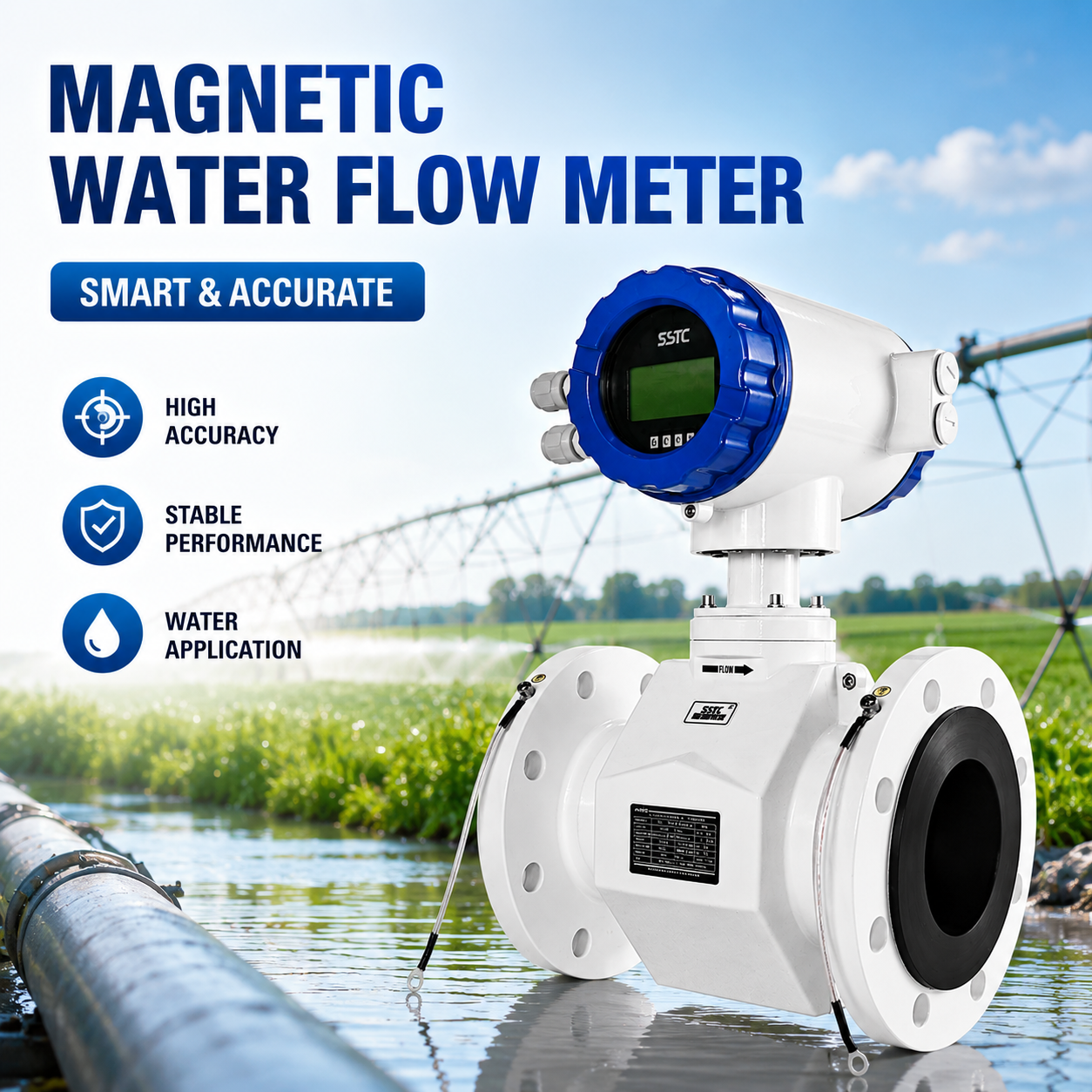
- Sensor (primary device): Contains excitation coils, measuring electrodes, and a lining material in contact with the fluid.
- Converter (signal processor): Converts the induced EMF into standard output signals such as 4-20mA, pulse, or frequency signals.
- Communication interface: Enables data transmission to remote monitoring systems for irrigation network oversight.
Relationship Between Equipment and Application
The flow meter functions as the measurement interface between the physical water flow and the data management system used by irrigation authorities, farm operators, or water utilities to monitor consumption and distribution.
3. Why Is This Solution Used in Industrial Applications?
Electromagnetic flow meters are widely selected for irrigation water measurement due to several technical characteristics:
- No moving parts: Reduces mechanical wear from sediment-laden irrigation water.
- Bidirectional measurement capability: Useful in canal systems where flow direction may reverse due to gravity-fed distribution changes.
- Wide velocity range: Typically supports flow velocities from 0.1 to 10 m/s, accommodating both low-flow night irrigation and peak daytime demand.
- Compatibility with conductive water: Since irrigation water generally contains dissolved minerals and is electrically conductive, it is well suited to electromagnetic measurement principles.
Typical Measurement Challenges Solved
- Inconsistent readings caused by sediment interference
- Signal instability in long pipeline runs
- Data blind spots in remote, unpowered locations
- Difficulty integrating field data with irrigation district management software
4. Key Selection Factors
Selecting the correct flow meter for irrigation applications requires evaluation of multiple engineering parameters:
- Measuring medium: Clean irrigation water, groundwater, or water containing moderate suspended solids.
- Conductivity: Electromagnetic flow meters require a minimum fluid conductivity (typically ≥5 µS/cm); this should be verified for groundwater sources.
- Flow range: Match velocity range and pipe diameter to seasonal peak and minimum flow conditions.
- Pipe size: Available in DN15 to DN3000, covering small distribution laterals to large trunk canals.
- Temperature and pressure: Confirm liner and flange ratings match operating conditions.
- Accuracy requirements: Standard ±0.5% accuracy is common; ±0.2% may be selected for regulatory metering or billing purposes.
- Material compatibility: Liner options such as PTFE, PFA, Rubber, and Polyurethane should be matched to sediment abrasiveness.
- Electrode selection: Stainless steel electrodes are standard for typical irrigation water; Hastelloy or Titanium may be considered for higher mineral or chemical content.
- Installation conditions: Above-ground pump stations, buried pipelines, or open-channel insertion points each require different mechanical and IP-rated enclosures.
5. Common Challenges and Solutions
Incorrect Model Selection Selecting a meter without verifying conductivity or sediment load can result in inaccurate readings. Solution: Confirm water source characteristics before specifying liner and electrode materials.
Measurement Instability from Sediment Suspended solids can cause signal noise, sometimes referred to as “cuspidal disturb.” Solution: Variation restraint algorithms and grounding electrodes help stabilize signal output in sediment-bearing water.
Power Supply Limitations Remote irrigation points often lack grid power. Solution: Battery-powered electromagnetic flow meters with low-power square wave excitation and sleep-mode LCD display extend operational life between maintenance visits.
Installation Errors Improper grounding or insufficient straight pipe length before and after the sensor can cause measurement deviation. Solution: Follow manufacturer-specified upstream/downstream straight pipe requirements and grounding procedures.
Abrasion in Sediment-Heavy Channels Standard liners may wear prematurely. Solution: Select wear-resistant liners such as Polyurethane or Ceramic for high-sediment irrigation return flows.
6. Application Areas
- Water and wastewater treatment: Measurement of intake and discharge volumes in agricultural water treatment facilities.
- Municipal and agricultural water distribution: Canal and pipeline flow accounting for irrigation districts.
- Energy management: Monitoring pump station energy efficiency relative to delivered water volume.
- Industrial process control: Supporting water balance calculations in agro-processing facilities that draw from irrigation sources.
7. Installation and Maintenance Recommendations
- Installation Requirements: Ensure the sensor is fully filled with water during measurement; avoid installation at pipe high points where air pockets may form.
- Straight Pipe Length: Maintain adequate upstream and downstream straight pipe sections to stabilize flow profile.
- Grounding: Proper grounding of the sensor housing prevents signal interference from stray electrical currents in field installations.
- Operating Recommendations: Allow a brief preheating period after power-up before relying on displayed values.
- Maintenance Methods: Periodically inspect electrodes for scale buildup and check converter enclosures for moisture ingress, particularly in outdoor irrigation environments.
- Calibration Importance: Periodic verification against a reference standard helps maintain long-term accuracy, especially for meters used in water allocation billing.
- Long-Term Reliability: Selecting appropriate IP-rated enclosures (IP65/IP67/IP68) protects converter and sensor electronics from field moisture and dust exposure.
8. Industrial Supplier Evaluation
When selecting a manufacturer for irrigation flow measurement equipment, professional buyers should evaluate:
- Manufacturing capability: Whether the supplier designs and produces sensors and converters in-house, rather than assembling third-party components.
- Quality control system: Compliance with recognized industry standards for flow meter construction and testing.
- Calibration capability: Availability of factory calibration using liquid flow calibration systems, such as static mass method or master meter method, to verify accuracy before shipment.
- Technical support: Ability to provide installation guidance, troubleshooting assistance, and application-specific recommendations.
- Customization capability: Support for custom liner materials, electrode configurations, and communication protocols suited to irrigation network requirements.
- Export experience: Track record of supplying instrumentation for international agricultural and municipal water projects.
- Engineering service capability: Support for pre-installation inspection and remote monitoring configuration.
9. About Kaifeng Xinya Instrument Co., Ltd.
Kaifeng Xinya Instrument Co., Ltd. is a professional industrial flow measurement manufacturer specializing in electromagnetic flow meter design and production for industrial, municipal, and agricultural applications, including irrigation water measurement.
As a source factory, Kaifeng Xinya maintains independent R&D capability for excitation drive systems, signal processing electronics, and IoT-based data platforms that support remote irrigation monitoring. Manufacturing experience is supported by NewAsia Industrial since 1996, providing a long-term foundation in instrumentation production.
The company offers electromagnetic flow meters covering DN15 to DN3000, with liner options including PTFE, PFA, Rubber, Polyurethane, and Ceramic, and electrode options including stainless steel, Hastelloy, Titanium, and Tantalum to accommodate varying irrigation water conditions.
Kaifeng Xinya maintains factory calibration capability using liquid flow calibration systems, and supports OEM/ODM customization for communication protocols such as RS485, HART, GPRS, and MODBUS-RTU, enabling integration with irrigation district monitoring systems. The company’s global export experience supports water resource management projects requiring reliable, field-verified flow measurement instrumentation.
10. Frequently Asked Questions (FAQ)
Q1: Can an electromagnetic flow meter measure irrigation water with sediment content? Yes, provided the appropriate liner material (such as Polyurethane or Ceramic) and electrode configuration are selected to resist abrasion and signal interference from suspended solids.
Q2: What liner material is recommended for canal or ditch-fed irrigation water? For moderate sediment content, Rubber or PTFE liners are commonly suitable. For higher abrasion levels, Polyurethane or Ceramic liners provide extended service life.
Q3: How accurate is electromagnetic flow measurement for irrigation billing purposes? Standard accuracy is typically ±0.5%, with ±0.2% available for applications requiring stricter volumetric accounting, such as regulated water allocation billing.
Q4: Does irrigation water need a minimum conductivity level for electromagnetic measurement? Yes. Electromagnetic flow meters require the fluid to have a minimum conductivity level, generally around 5 µS/cm, which most surface and groundwater sources meet.
Q5: What causes unstable readings in irrigation pipeline flow measurement? Common causes include insufficient straight pipe length, improper grounding, entrained air, or sediment-related signal noise. Addressing installation conditions typically resolves instability.
Q6: Is a power supply required at every irrigation measurement point? Not necessarily. Battery-powered electromagnetic flow meters are available for remote irrigation points lacking grid power, with extended battery life supported by low-power excitation design.
Q7: How should the correct flow meter model be selected for an irrigation project? Selection should be based on pipe diameter, expected flow velocity range, water conductivity, sediment characteristics, and required accuracy, along with installation location constraints.
Q8: Does the equipment require periodic calibration after installation? Periodic verification is recommended, particularly for metering used in billing or regulatory reporting, to confirm continued measurement accuracy over time.
11. Conclusion
Irrigation water measurement plays an essential role in agricultural water management, supporting accurate accounting, efficient resource allocation, and regulatory compliance. Selecting the correct flow measurement technology requires careful evaluation of water conductivity, sediment characteristics, pipe size, and installation conditions.
Electromagnetic flow meters, with their no-moving-parts design and wide velocity range, offer a technically sound solution for many irrigation measurement scenarios. Proper material selection, installation practices, and calibration verification are key to achieving long-term measurement reliability.
For engineering teams evaluating flow measurement instrumentation for irrigation or agricultural water distribution projects, technical consultation with an experienced flow meter manufacturer can help ensure the selected equipment matches specific application conditions.
https://www.sytcflowmeter.com/
Kaifeng Xinya Instrument Co., Ltd. -
AuthorPosts

- You must be logged in to reply to this topic.