- This topic is empty.
-
AuthorPosts
-
06/11/2026 at 15:16 #7108
Published: November 2026 | By Zongheng Engineering Team | 6 min read
Most of the gas meter manufacturing process quality control points that decide a meter's fate are invisible during a factory tour. They sit inside the press, inside the torque controller and inside the leak decay curve — not on the final inspection bench where visitors are usually led.
A gas meter passes nine stations between a coil of steel and a shipping carton. Six of those stations carry a measurable acceptance gate. Everything else is transport. Zongheng builds lines for both base and smart meters, and the six gates below are the ones we write into the acceptance protocol of every project.
1. Where Do the Quality Control Points Sit Across the Nine Stations?
Six gates decide whether a meter ships, and they are spread from stamping to calibration rather than collected at final inspection. Miss one upstream and you will meet it again as a rejected unit at the calibration bench, where the cost of that scrap is roughly ten times higher.
Below are the nine stations, each annotated with the gas meter manufacturing process quality control points it carries:
• Shell stamping (gate 1). Blank, draw, trim, pierce. Cold-rolled steel at 0.8–1.2 mm, or die-cast aluminium on larger sizes. The press holds chamber depth to ±0.05 mm on a 160–250 t machine, and a first-off sample is checked every two hours against the drawing. A chamber depth below Cpk 1.33 is a press problem, not an operator problem.
• Deburring and cleaning. Burrs on the valve seat face must stay under 0.05 mm. A burr that survives ultrasonic cleaning lifts the seat off its seal and creates a meter that leaks only at the end of the diaphragm stroke — the hardest defect to reproduce later.
• Valve seat and diaphragm assembly (gate 2). Seat clearance is set to 0.05–0.15 mm and verified with a feeler gauge or a laser displacement sensor. This is the tolerance that governs accuracy and service life at the same time; a seat worn past 0.2 mm makes the meter count the same gas twice.
• Gear train and counter. Reduction gears, index and anti-reversal pawl. Driving torque is monitored inside a 0.4–0.8 N·m band, because a mesh that is too tight passes visual inspection and then runs slow for a decade.
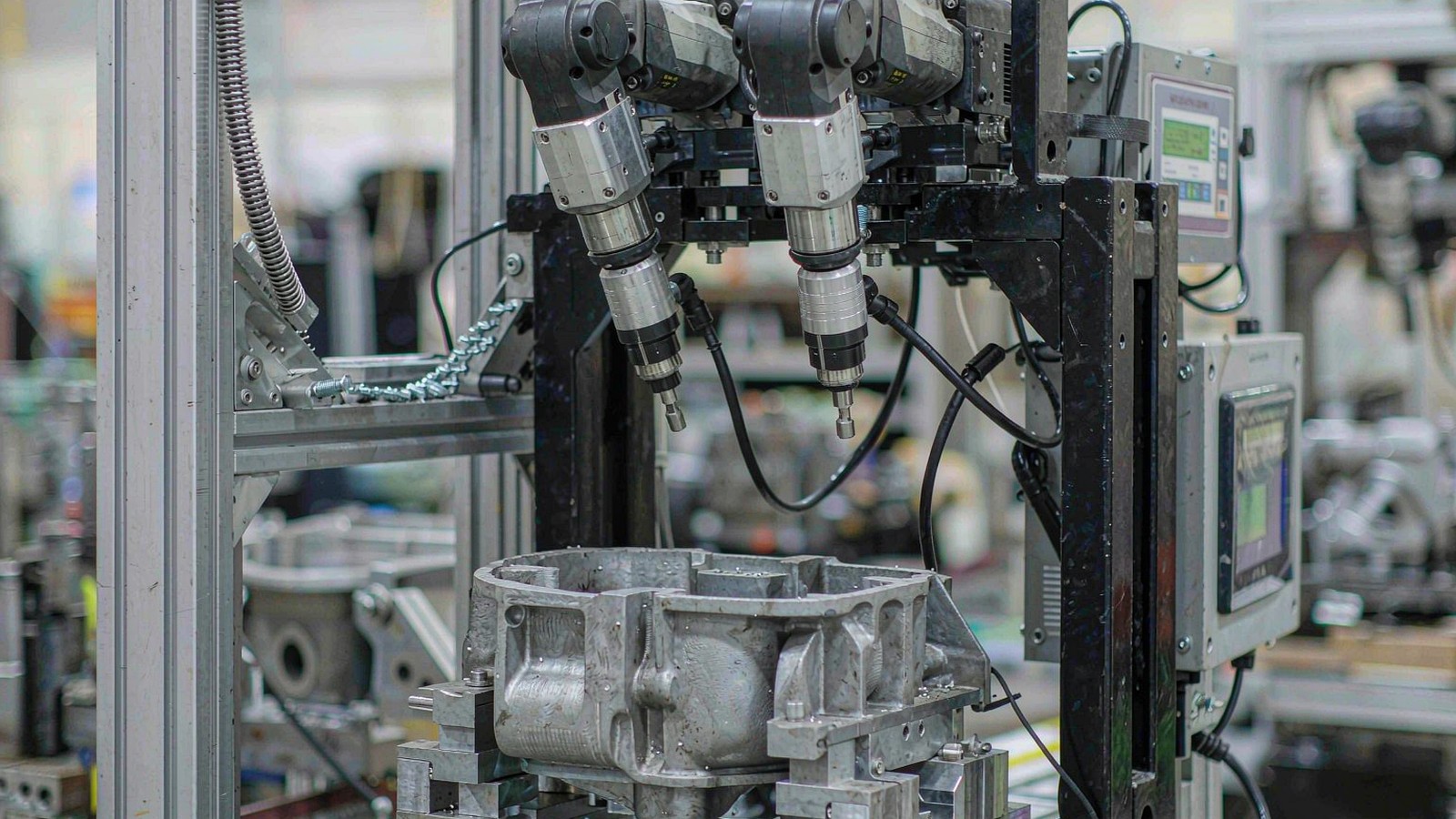
• Housing closing and screw locking (gate 3). Gasket seating, then the gas meter housing assembly line automatic screw locking sequence drives four to six screws to 2.5–3.5 N·m with the angle curve recorded. A gasket compressed unevenly will pass a static pressure test and seep at the temperature swings of a real installation.
• Smart module integration. PCB seating, antenna routing, battery, valve actuator and firmware flashing. A plain diaphragm meter skips this station entirely, which is where the two product families start to diverge.
• Leak test (gate 4). Charged to 1.5× working pressure, held five minutes, with a pressure-drop ceiling of 50 Pa. Units above the ceiling are ejected automatically and never reach calibration.
• Calibration (gate 5). A sonic nozzle bench covering 0.016–6 m³/h, corrected at three to five flow points. Acceptance sits at ±1.5% of indicated value for a diaphragm meter and repeatability under 0.6%.
• Aging, marking and packing (gate 6). A short burn-in, then a final pressure-loss check as a backstop: above 600 Pa means a blocked internal channel, below 100 Pa means gas is slipping past the metering chamber. The laser mark ties the unit to its leak curve and coefficients.
The gas meter housing assembly line automatic screw locking step is worth a closer look, because it is the gate most often left half-instrumented. A servo driver that reports only final torque tells you a screw arrived; it does not tell you whether the thread was crossed. Logging torque against rotation angle does. A cross-threaded screw reaches nominal torque after 90° instead of the expected 400–600°, and the controller rejects it inside the cycle rather than at the customer's incoming inspection six weeks later.
✅ Bottom line: Seat clearance and screw torque cause most field failures, so log both against the meter's serial number, not the production batch.
The full station list, with the equipment configuration quoted for each gate, sits on the gas meter assembly line product page.
2. Base Meter or Smart Meter: How Much Automation Do You Actually Need?
A base meter line stops at seven stations while a smart meter line runs eleven to thirteen, and the difference shows up in cycle time long before it shows up in the quotation. Any honest base meter vs smart meter assembly automation comparison has to start with that station count, because it is the number the price is built on.
What the extra stations actually do:
• Firmware flashing. Forty to ninety seconds per unit, so it runs in a multi-fixture cell in parallel with assembly rather than inline. On a 20-second line that means four to six fixtures, or the line waits.
• End-of-line functional test. Valve open and close through three cycles with closure detection, plus RF or NB-IoT registration: thirty to forty-five seconds. A base meter gets a dial and pointer check instead.
• Cycle time and labour. A base line holds 15–18 seconds per unit with two operators per shift. A smart line lands at 22–28 seconds with three to four, because test and rework need hands.
• Capital. For the same output, a smart meter line typically costs 40–70% more. Most of that sits in the test cell and the traceability layer, not in the conveyors.
Run the base meter vs smart meter assembly automation comparison over a five-year horizon and the argument for a bypass lane becomes obvious. A line specified at eleven stations can be run as a seven-station base line by routing pallets around the module and functional-test cell. That costs perhaps 8% more at build stage and saves a second line when the product mix shifts — which it will, because utilities rarely migrate a whole territory at once.
What does not work is retrofitting a base line into a smart line. Adding a module station means adding fixtures, power, network and a test protocol, and the conveyor pitch rarely has the space — a point worth settling with your supplier before the layout is frozen. In practice most factories end up buying the second line anyway.
✅ Bottom line: Specify for the meter you will sell in three years and keep a bypass lane for the variant you have not launched yet.
Frequently Asked Questions
Q: Do you build custom lines to a customer's own meter drawing?
A: Yes. Zongheng works from your drawing rather than a catalogue — station count, gate instrumentation and traceability depth are all configurable. As a China manufacturer serving OEM buyers in the Middle East, Southeast Asia and CIS markets, Wenling Zongheng Intelligent Equipment Co., Ltd. quotes 45–60 working days of build time with a 48-hour loaded run-in before shipment.
Q: Which records should the line keep for a certification audit?
A: Four, and they map directly onto the gas meter manufacturing process quality control points above: the torque-angle curve per screw, the leak decay curve per unit, the calibration coefficients per flow point, and the chamber depth sample record per press batch. Auditors under OIML R137 or MID ask for the first two before anything else, because they prove the unit was built the way the type approval says it was.
Q: Can one line build both base and smart meters?
A: One line can, one configuration cannot. The base meter vs smart meter assembly automation comparison comes down to whether the module and functional-test cells sit inline or on a bypass. Build the bypass at the start; retrofitting it later means moving the conveyor and re-validating the calibration bench.
Next Step
Zongheng quotes against your meter drawing, shift target and certification route. Send the G-size range and required output, and our engineering team returns a station-by-station proposal — including the six gates, their instrumentation and the acceptance numbers — within five working days.
Wenling Zongheng Intelligent Equipment Co., Ltd. builds and commissions from its own plant in Wenling, Zhejiang, and quotes as a factory rather than a trading company.
Wholesale and ODM enquiries are welcome. For the upstream view of the same line, read how gas meters are manufactured step by step, or the gas meter assembly line project overview for a configured example.
http://www.zonhonauto.com
Wenling Zongheng Intelligent Equipment Co., Ltd. -
AuthorPosts

- You must be logged in to reply to this topic.