- This topic is empty.
-
AuthorPosts
-
25/06/2026 at 22:28 #6010
Flow measurement accuracy forms the backbone of industrial process control, utility billing, and regulatory compliance across water treatment, chemical processing, and energy sectors. As measurement requirements become increasingly stringent, understanding calibration methodologies has become critical for facility managers and instrumentation engineers. Two primary approaches dominate the flow calibration landscape: static mass method and master meter method. While both serve the fundamental purpose of verifying flowmeter accuracy, their operational principles, uncertainty levels, and application contexts differ significantly.
Understanding Static Mass Method Calibration
The static mass method represents the most direct approach to flow calibration, establishing traceability through fundamental mass measurement principles. This technique involves collecting fluid discharged from a flowmeter under test into a weigh tank over a precisely timed interval. The method derives volumetric flow by dividing the collected mass by fluid density and elapsed time, creating a measurement chain traceable to primary standards for mass and time.
Kaifeng Xinya Instrument Co., Ltd. has implemented static mass method systems achieving measurement uncertainty as low as 0.05% under typical laboratory conditions. This exceptional precision stems from eliminating intermediate measurement devices—the calibration references only certified mass standards and atomic time references. The company’s liquid flow calibration systems accommodate flowmeters ranging from small laboratory instruments to large industrial units, with some configurations supporting diameters from DN6 to DN1500 depending on system design.
The operational sequence follows a rigorous protocol: fluid flows through the test meter into a diversion system that switches flow into the weigh tank at the calibration start point. After a predetermined volume passes, the system diverts flow away from the tank while simultaneously recording the exact time interval. High-precision load cells measure the collected mass, and temperature sensors provide data for density compensation. Automated PLC and industrial PC-based systems manage timing, data acquisition, and calculation processes, minimizing human error while maintaining comprehensive digital records for metrological traceability.
Master Meter Method: Comparative Measurement Approach
The master meter method employs a different philosophical approach, using a previously calibrated reference flowmeter as the measurement standard. In this configuration, the master meter and test meter install in series, experiencing identical flow conditions. The system compares readings between the two instruments, with deviations indicating the test meter’s measurement error.
Kaifeng Xinya Instrument has developed master meter calibration systems with typical uncertainty levels reaching 0.2%. While this represents slightly higher uncertainty than static mass methods, the approach offers distinct operational advantages. Master meter systems require significantly less infrastructure—no large weigh tanks, complex fluid diversion mechanisms, or high-capacity precision scales. The comparative nature enables continuous flow testing without the start-stop cycles inherent to gravimetric methods, allowing faster throughput when calibrating multiple instruments.
The measurement chain in master meter systems depends critically on the reference instrument’s stability and calibration status. Master meters themselves require periodic recalibration against primary standards, creating a hierarchical traceability structure. Advanced implementations incorporate multiple master meters spanning different flow ranges, with automated valve systems directing flow through the appropriate reference instrument based on test conditions.
Uncertainty Analysis: Where Precision Differs
The 0.05% versus 0.2% uncertainty comparison reveals fundamental differences in error source distribution. Static mass method uncertainty primarily derives from:
- Load cell linearity and resolution in mass measurement
- Timing precision in flow period determination
- Density calculation accuracy from temperature and pressure data
- Tank geometry effects on fluid settling and evaporation
Each component contributes independently, with careful system design minimizing cumulative effects. The direct measurement approach eliminates instrument-related errors present in comparative methods.
Master meter method uncertainty incorporates additional factors:
- Reference meter’s inherent uncertainty from its own calibration
- Flow profile matching between master and test positions
- Installation effects including pipe length requirements and flow conditioning
- Master meter drift between calibration intervals
The serial installation requirement means both meters must operate within their optimal performance ranges simultaneously—a constraint that can limit flexibility when testing meters with wide turndown ratios.
Application Context: Matching Method to Need
Industrial metrology facilities face challenges that influence calibration method selection. As identified in Kaifeng Xinya Instrument’s application experience, flow instability, air bubbles, turbulence, pressure fluctuations, and long-term drift all impact measurement reliability. These factors affect calibration methodology differently.
Static mass systems excel when:
- Maximum accuracy is required for custody transfer applications or primary standard maintenance
- Regulatory compliance demands traceability to fundamental units
- Calibration frequency is relatively low, justifying higher infrastructure investment
- Test conditions can be carefully controlled in laboratory environments
The method’s precision makes it essential for facilities maintaining measurement hierarchies, where reference instruments require validation against the most accurate standards available. Water utilities performing revenue meter calibration and national metrology institutes establishing regional standards typically employ static mass systems.
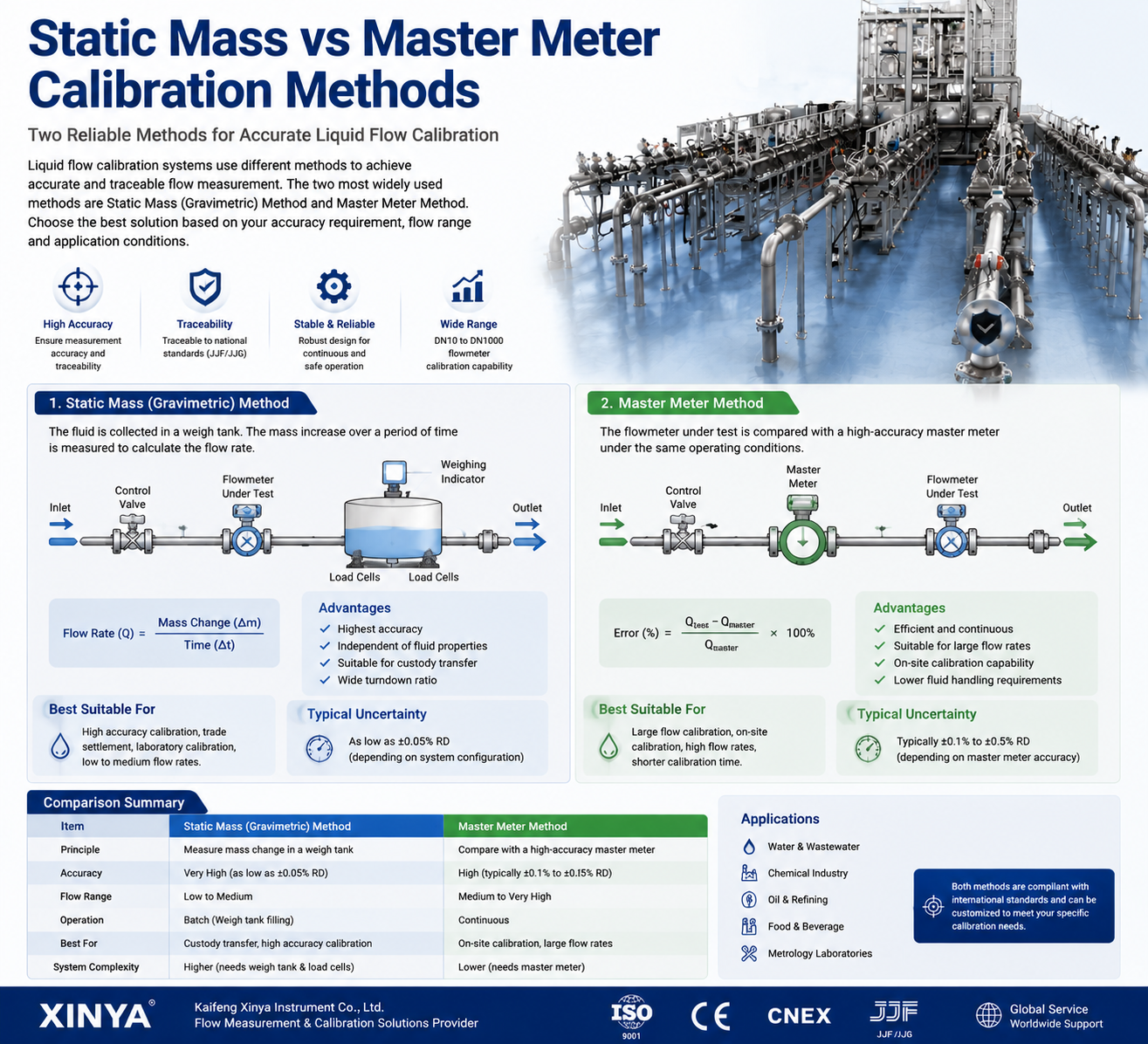
Master meter approaches prove advantageous when:
- Throughput requirements necessitate rapid testing of multiple instruments
- Field conditions make gravimetric measurement impractical
- Moderate uncertainty (0.2%) satisfies application requirements
- Space and infrastructure constraints limit installation options
Chemical plants performing routine instrument verification and industrial facilities with onsite calibration capabilities often implement master meter systems. The comparative approach particularly suits applications where consistency matters more than absolute accuracy—ensuring multiple process meters read consistently relative to a stable reference.
System Integration and Automation Capabilities
Modern calibration facilities increasingly emphasize automation and data management. Kaifeng Xinya Instrument’s systems incorporate automated report generation based on measurement data and digital record keeping for traceability, addressing regulatory requirements while improving operational efficiency.
Static mass systems benefit from automation in the complex timing and diversion sequences. Pneumatic or hydraulic diverters must switch flow paths within milliseconds to prevent measurement errors, while data acquisition systems simultaneously capture mass, temperature, pressure, and time data. The computational intensity of density correction and uncertainty propagation calculations makes automated processing essential.
Master meter systems leverage automation differently, focusing on continuous comparison algorithms and real-time deviation analysis. The systems can implement statistical process control techniques, identifying trends that might indicate master meter drift or test meter instabilities. Integration with industrial metering and process monitoring solutions enables facility-wide calibration scheduling based on instrument performance tracking rather than arbitrary time intervals.
Certification and Quality Assurance Framework
The credibility of any calibration method depends on its quality management structure. Kaifeng Xinya Instrument operates under ISO 9001:2015 Quality Management System Certification and holds Pattern Approval Certificate of Measuring Instruments from the People’s Republic of China. The company’s calibration systems are certified by the Henan Institute of Metrology, establishing them as a Provincial Authority Certified Flow Standard Device Manufacturer.
These certifications ensure calibration systems meet metrological requirements regardless of method. Static mass systems undergo validation comparing their results against national primary standards, while master meter systems verify their reference instruments through traceable calibration chains. Both approaches support the fundamental requirement: providing measurement uncertainty statements that users can incorporate into their own uncertainty budgets.
Making the Strategic Choice
Selecting between static mass and master meter calibration methods requires evaluating accuracy requirements against practical constraints. For applications demanding measurement uncertainty below 0.1%, static mass methods remain the definitive choice despite higher infrastructure investment. When operational flexibility and throughput matter more than ultimate precision, master meter systems offer compelling advantages within their 0.2% uncertainty capability.
Kaifeng Xinya Instrument’s portfolio encompasses both approaches, reflecting the diverse needs across water industry, energy and gas, chemical industry, agriculture, and mining sectors. The company’s capability to design and manufacture calibration systems using either methodology—or hybrid implementations combining both approaches—enables tailored solutions matching specific facility requirements.
Understanding these methodological differences empowers instrumentation professionals to specify appropriate calibration services, ensuring their flow measurement systems maintain the reliability demanded by modern industrial processes. Whether optimizing for maximum accuracy or operational efficiency, recognizing the distinct strengths of static mass and master meter approaches forms the foundation of effective measurement quality management.
https://www.sytcflowmeter.com/
Kaifeng Xinya Instrument Co., Ltd. -
AuthorPosts

- You must be logged in to reply to this topic.