- This topic is empty.
-
AuthorPosts
-
13/11/2026 at 11:12 #7169
For distributors, lighting wholesalers, engineering contractors, and commercial project buyers, finding a dependable LED strip light manufacturer in China is an essential part of successful bulk purchasing. Beyond offering competitive prices, a professional factory should be capable of delivering stable product quality, maintaining production efficiency, providing flexible customization, and supporting customers throughout the purchasing process.
However, the manufacturing capabilities of LED strip light suppliers can vary considerably. While some companies mainly supply conventional lighting products, others invest more heavily in product development, advanced manufacturing equipment, systematic quality inspections, and specialized lighting technologies.
LED Strip Light Factory in China
If you are preparing to purchase LED strip lights in large quantities, it is important to look beyond product prices and catalog selections. Understanding a manufacturer's technical expertise, production capacity, quality assurance procedures, and customer service can help you identify a suitable long-term business partner.
Below are eight important aspects to examine when selecting an LED strip light factory in China.
1. Understand the Manufacturer's Industry Experience and Production Background
A good starting point is to investigate the manufacturer's actual business focus and manufacturing history. Factories dedicated to LED strip lighting generally have more specialized knowledge of LED components, flexible circuit boards, heat dissipation, waterproof structures, and lighting performance than companies that handle a wide range of unrelated products.
When communicating with potential suppliers, find out how long they have been operating, which products they manufacture, what production facilities they have, and whether they have experience working with international customers. Factory images, manufacturing videos, product catalogs, and online factory inspections can provide additional insight into their operations.
It is equally important to distinguish between genuine manufacturers and trading companies. Ask whether critical manufacturing procedures are completed internally or outsourced to third parties. Having direct control over production can make it easier to manage product consistency, manufacturing schedules, and quality issues.
For wholesale purchasing, prioritize manufacturers with established production systems and experience fulfilling repeated orders. Consistent specifications across different production batches are essential for distributors and businesses that need to maintain a stable product offering.
Quanhe Lighting Co., Ltd. is one example of a specialized lighting manufacturer. Founded in 2015, the company focuses on premium linear lighting solutions, including flexible LED strip lights, LED neon flex, flexible LED wall washers, and aluminum linear lighting products. Its product portfolio serves a variety of architectural, commercial, landscape, and residential lighting applications.
2. Investigate Research and Development Strength
The performance of an LED strip light is influenced by much more than its assembly process. Factors such as LED chip selection, PCB engineering, electronic component compatibility, thermal management, and protective materials all contribute to the finished product's reliability.
Manufacturers with dedicated R&D departments are generally better equipped to optimize existing products, introduce new technologies, and respond to specific customer requirements.
During supplier evaluation, consider asking the following questions:
-
Does the manufacturer operate an independent product development team?
-
Can it adjust product dimensions, voltage, color temperature, or lighting functions?
-
Is it capable of developing solutions for different indoor and outdoor environments?
-
Does it have independent product design and technical development capabilities?
-
Can it manufacture evaluation samples before starting mass production?
Quanhe Lighting identifies technological development as an important part of its business strategy. Based on the company's published information, its R&D employees represent approximately 15% of the total workforce, and its annual R&D expenditure accounts for more than 8%. It has also submitted applications for over 20 patents.
Such investment can be valuable for customers looking for customized linear lighting rather than standard products alone. Projects involving special dimensions, particular installation environments, or specific lighting effects may require additional engineering support.
Before approving a bulk purchase, communicate your technical expectations clearly and request samples manufactured according to the proposed specifications. Sample evaluation helps identify design or performance problems before they become costly issues during large-scale production.
3. Investigate Quality Assurance and Inspection Procedures
Product consistency is a major concern when purchasing LED strip lights in bulk. Even a relatively small percentage of defective products can create considerable losses when an order contains thousands of meters of lighting products.
Rather than accepting a general statement that a supplier maintains strict quality standards, ask for an explanation of its inspection procedures and quality management practices.
A comprehensive quality assurance system should normally include the following stages.
Raw Material Inspection
Before production begins, incoming materials should be checked for quality and consistency. Important components include LED chips, flexible PCBs, electrical connectors, adhesives, and waterproof protective materials. Poor-quality components may result in inconsistent brightness, unstable electrical performance, or reduced product lifespan.
Manufacturing Process Inspection
Quality monitoring should continue throughout production. Depending on the product structure, inspection points may include soldering quality, circuit connections, electrical parameters, protective coating, and waterproof treatment.
Finished Product Testing
Before packaging, completed LED strip lights should be evaluated through suitable visual, electrical, and functional inspections. Brightness consistency, operating performance, and product appearance are among the factors that may need verification.
Production Batch Management
Reliable manufacturers should maintain production and inspection records for different batches. These records help trace material sources, manufacturing processes, and quality results if customers report problems after receiving their orders.
Quanhe Lighting states that it applies quality management procedures throughout its manufacturing operations in accordance with ISO 9001 requirements. Its reported inspection and reliability testing capabilities include salt spray testing, temperature cycling, repeated drop testing, and IP68 immersion testing when relevant to the product.
Each procedure serves a different purpose. Temperature cycling evaluates how products respond to repeated temperature changes, while salt spray testing helps assess corrosion resistance under appropriate environmental conditions.
When reviewing a manufacturer's quality documentation, confirm whether the listed procedures apply to the exact product you intend to purchase. Testing results from one model or configuration should not be considered automatic verification of all products in the supplier's range.
4. Match Waterproof Performance to the Intended Application
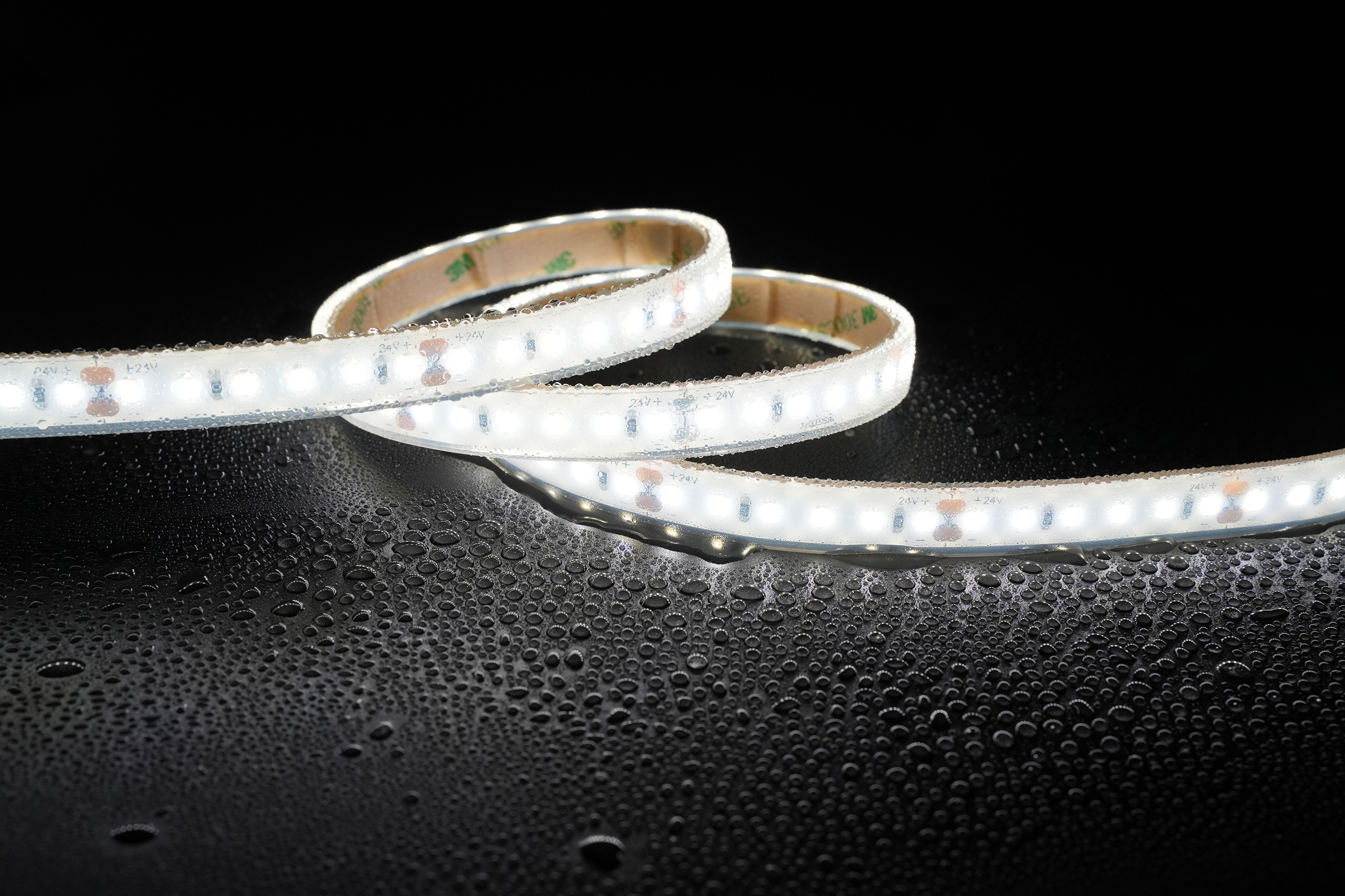
Water resistance is an important technical consideration for LED strip lights used in gardens, outdoor buildings, landscape installations, commercial facades, and other environments exposed to moisture.
Although IP protection ratings provide useful information, they should not be the only factor used to determine product suitability. The complete construction, connection points, cable entries, installation accessories, and surrounding environmental conditions also influence waterproof performance.
For instance, decorative lighting installed inside a dry shopping mall may only require basic protection, whereas outdoor architectural lighting may need stronger resistance to rain, humidity, and temperature fluctuations. Products designed for underwater environments require even more specific verification of their construction and operating limitations.
Before selecting a model, clarify the following details:
-
The IP protection level required for the actual installation environment.
-
Whether the specified rating covers the entire product assembly.
-
The appropriate installation procedure and supporting accessories.
-
Permitted operating temperatures and environmental conditions.
-
Availability of relevant waterproof testing reports.
For projects with demanding environmental requirements, ask the manufacturer to explain its waterproof construction methods and how these are checked during production. This provides more practical assurance than simply relying on an IP rating printed in a product catalog.
Quanhe Lighting continues to develop its flexible lighting products through improvements in materials, protective structures, and lighting technology. Its LED strip lights, neon flex products, and flexible wall washers provide different options for architectural and decorative lighting projects. Buyers should select the appropriate configuration according to their actual application requirements.
5. Evaluate Manufacturing Capacity and Order Fulfillment
A manufacturer may provide excellent product samples, but that does not necessarily mean it can handle large-volume orders efficiently. For wholesale businesses and project contractors, production capacity and delivery reliability are just as important as product quality.
Insufficient manufacturing resources, unstable component supplies, or limited inspection capacity may lead to production delays and inconsistent deliveries.
Before confirming an order, discuss these operational details with the supplier:
-
Typical manufacturing lead times and existing production commitments.
-
Minimum order quantities for regular and customized products.
-
Availability of essential components and alternative sourcing arrangements.
-
Production planning for repeat purchases.
-
Quality inspection and packaging schedules.
-
Solutions for unexpected production delays or order adjustments.
A professional supplier should be able to provide a realistic production schedule and confirm the agreed delivery arrangements in writing.
For lighting projects involving multiple installation phases, it is worth discussing whether manufacturing and shipment can be arranged according to the project's progress. This can help avoid unnecessary inventory pressure and installation interruptions.
Also consider whether the factory can maintain consistent specifications when handling repeat orders. Keeping approved samples, product drawings, material requirements, and technical specifications on record can help minimize differences between production batches.
Remember that manufacturing capacity should be evaluated according to your specific order requirements. A factory may have sufficient resources for standard LED strips but need additional preparation time for specialized connectors, customized dimensions, or different waterproof structures.
6. Consider Custom Manufacturing and After-Sales Technical Assistance
Different customers have different expectations for LED strip lighting. Depending on the project, specifications may involve operating voltage, power consumption, LED density, color temperature, color rendering index, dimming functions, cutting distance, and installation methods.
A capable manufacturer should be able to explain its available customization options and identify which requirements can be fulfilled through standard production or require additional engineering development.
Technical assistance is another important factor. During installation, lighting contractors may encounter problems involving uneven illumination, power compatibility, connection methods, or mounting arrangements. Timely and accurate guidance from the factory can help reduce troubleshooting time and unnecessary project costs.
To improve communication, prepare a detailed technical document before requesting customization. Include product dimensions, installation drawings, operating conditions, required lighting effects, and destination-market certification requirements.
Quanhe Lighting provides customized linear lighting solutions in addition to its standard product offerings. Its experience in high-end lighting applications can be useful for architectural projects, hotels, museums, landscape lighting, and modern residential spaces where product dimensions and lighting effects may require specific adjustments.
When comparing manufacturers, review their complete product catalogs and technical information to understand the range of solutions they can provide. More information about available lighting products and manufacturing services can be found on the LED strip light manufacturer's official website.
7. Check Product Certifications and International Trade Documentation
For international buyers, product documentation and regulatory compliance should be considered before placing an order. Different countries and application environments may have different requirements regarding electrical safety, electromagnetic compatibility, hazardous substances, and product labeling.
Depending on the target market, relevant documentation may include:
-
Electrical safety certification and supporting reports.
-
Electromagnetic compatibility documentation.
-
RoHS compliance information.
-
Product technical specifications.
-
Reliability and performance test reports.
-
Installation and operating instructions.
It is important to verify that the documents correspond to the actual product model and configuration being purchased. A manufacturer may have certifications covering certain product series without necessarily having the same documentation for every item in its catalog.
In addition to product compliance, overseas buyers should evaluate the supplier's export experience. Proper packaging, shipping labels, commercial documentation, and consistent product identification can all contribute to smoother international order fulfillment.
Communication arrangements should also be clarified in advance. Find out who will handle technical inquiries, production updates, inspection coordination, shipping information, and after-sales support.
A supplier with an experienced international sales and technical service team can make cooperation more efficient, particularly when customers need to manage large orders or resolve technical issues across different time zones.
8. Request Samples and Conduct Product Evaluation
No matter how impressive a manufacturer's website, certifications, or factory introduction may appear, actual product evaluation remains an essential step before approving a large order.
Request samples that use the same materials, components, and manufacturing specifications planned for mass production. This makes the evaluation more representative of the products you will eventually receive.
When examining LED strip light samples, pay attention to these areas:
-
Light output, brightness uniformity, and color consistency.
-
PCB quality, soldering details, and overall manufacturing workmanship.
-
Cutting marks, electrical connections, and installation flexibility.
-
Compatibility with the specified power supply and dimming equipment.
-
Heat generation during normal operating conditions.
-
Waterproof construction and relevant supporting test reports, when required.
For projects involving substantial quantities, evaluating multiple samples can provide a more reliable understanding of product consistency. Buyers may also arrange an independent or third-party pre-shipment inspection based on previously agreed quality standards.
After approving the sample, keep a record of the technical specifications and retain a reference sample whenever possible. These records can serve as a comparison standard for subsequent production orders and help prevent unauthorized changes to product materials or performance.
Conclusion
Selecting a trustworthy LED strip light manufacturer in China for wholesale and bulk purchasing involves much more than comparing prices or reviewing product catalogs. Buyers should carefully evaluate manufacturing experience, R&D investment, quality management, waterproof construction, production resources, customization services, export documentation, and sample performance.
The best manufacturing partner is not necessarily the company offering the largest product selection. More importantly, it should be able to maintain consistent production standards, meet agreed technical requirements, deliver orders on schedule, and provide effective support as your business develops.
Quanhe Lighting Co., Ltd. is an example of a specialized manufacturer focusing on high-end linear lighting products. Its product development investment, customized lighting capabilities, and multi-stage quality management provide several aspects for potential customers to evaluate when considering a manufacturing partnership.
Before making your final supplier selection, prepare clear purchasing specifications, compare manufacturing capabilities, examine product samples, and establish written agreements covering quality standards and delivery arrangements.
Taking these precautions can help distributors, wholesalers, lighting contractors, and project developers reduce purchasing risks, improve supply chain stability, and establish long-term cooperation with a reliable LED strip light factory in China.
http://uc-led.com
Quanhe Lighting Co., Ltd. -
-
AuthorPosts

- You must be logged in to reply to this topic.