- This topic is empty.
-
AuthorPosts
-
02/11/2026 at 19:28 #7056
■ 1. Background
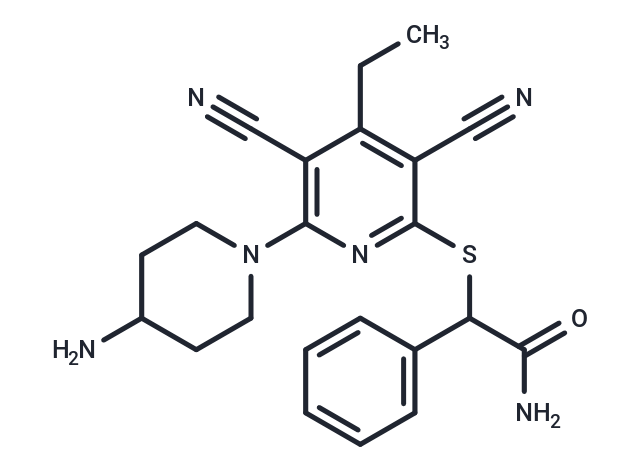
▲ GSK3685032 (T9573),CAS: 2170137-61-6
GSK3685032 (T9573), CAS: 2170137-61-6 is a non-covalent, selective inhibitor of DNA methyltransferase 1 (DNMT1) with an IC50 of 36 nM. DNMT1 is the principal maintenance methyltransferase that copies 5‑methylcytosine patterns onto nascent DNA strands during S phase, guided by hemi-methylated CpG substrates and scaffolded at replication foci through interactions with PCNA and the E3 ligase/reader UHRF1, whose SRA domain recognizes hemi-methylated DNA [1,2]. By inhibiting DNMT1 in a time-independent and reversible manner, GSK3685032 directly reduces catalytic turnover without covalent adduct formation, enabling precise temporal control of DNMT1 activity in living cells and biochemical systems.
In the DNA methyltransferase pathway, DNMT1 preserves epigenetic memory and contributes to chromatin states that enforce transcriptional programs. Methylated CpG sites recruit methyl-CpG–binding proteins and associated corepressors, stabilizing repressive chromatin and silencing promoters and regulatory elements. Disruption of DNMT1 activity therefore propagates passive demethylation across cell divisions, progressively eroding CpG methylation at sites that would otherwise be maintained [1]. Consistent with this mechanism, GSK3685032 induces loss of DNA methylation and leads to transcriptional activation, indicating re-expression of loci previously held in a methylation-dependent repressed state. Because inhibition is reversible, withdrawal of GSK3685032 allows researchers to examine the kinetics of methylation re-establishment and the plasticity of DNMT1-governed gene regulation.
GSK3685032 modulates the pathway by selectively targeting DNMT1, thereby decoupling maintenance methylation from de novo methylation mediated by other DNMT family members. This selectivity enables experiments that attribute changes in the methylome and transcriptome specifically to deficits in maintenance copying rather than to aberrant deposition of new methyl marks. The compound provides a high-affinity, non-covalent probe that can be titrated to partially or fully suppress DNMT1, supporting dose–response studies that relate catalytic inhibition to locus-specific demethylation, chromatin remodeling, and RNA output. In cancer cell models, GSK3685032 inhibits cell growth, aligning with the concept that epigenetic repression supports proliferative programs and that dismantling maintenance methylation can disrupt such states.
As a research tool, GSK3685032 is well suited for: (i) mapping DNMT1-dependent maintenance sites using whole-genome bisulfite or enzymatic methyl-seq in time-course designs; (ii) integrating chromatin assays (e.g., ATAC-seq, ChIP-seq for methyl-binding proteins or histone modifications) to link DNA demethylation with chromatin accessibility; (iii) RNA-seq to capture transcriptional activation cascades following DNMT1 inhibition; and (iv) combinatorial perturbations with readers/writers such as UHRF1 to dissect interdependencies within the maintenance machinery [2]. Its reversibility and potency support mechanistic studies of epigenetic memory, lineage fidelity, and the stability of silenced genomic elements under selective pressure.
■ 2. Literature review
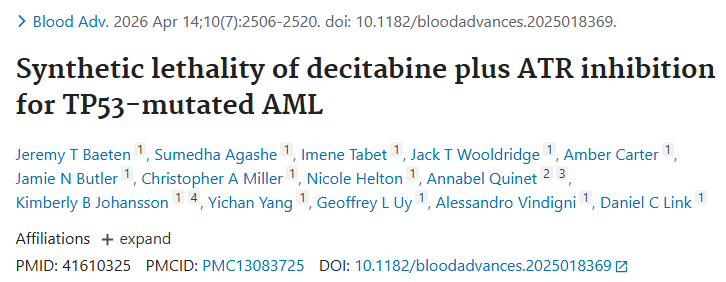
■ 2.1 Synthetic lethality of decitabine plus ATR inhibition for TP53-mutated AML.
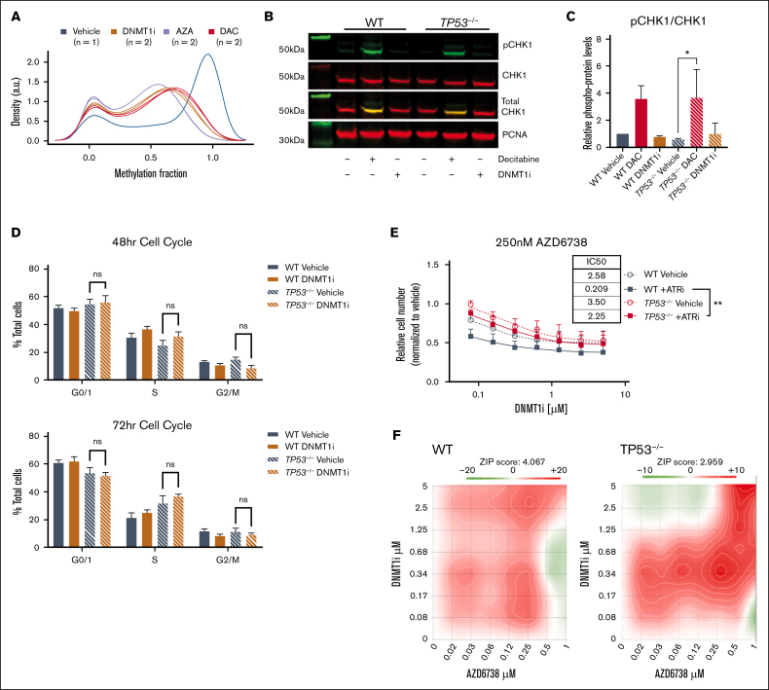
▲ (A) Density plot of the methylation fraction of all CpGs by whole-genome bisulfite sequencing in MOLM13 cells after treatment with vehicle, 0.1 μM GSK3685032 (DNMT1i), 0.2 μM decitabine, or 1 μM azacitidine. (B) Representative Western blot of WT and TP53−/− MOLM13 cells treated with vehicle, 0.2 μM decitabine, or 0.1 μM GSK3685032 for 48 hours; proliferating cell nuclear antigen (PCNA) loading control. (C) Densitometry analysis of the ratio of pCHK1 to total CHK1 in (B) (n = 3); significance determined by Tukey test. (D) EdU cell cycle flow cytometry of WT and TP53−/− MOLM13 cells treated with vehicle or 0.1 μM GSK3685032 for 48 or 72 hours (n = 4); significance determined by Tukey test. (E) DNMT1i dose-response curves in WT or TP53−/− MOLM13 cells after 96 hours of vehicle or 0.25 μM AZD6738. n = 3, significance determined by nonlinear regression curve fit. Data represent the mean ± SEM. (F) Representative ZIP Synergy matrices for dose-response experiments combining DNMT1i and AZD6738 in WT and TP53−/− cells for 96 hours (n = 3). ∗P < .05, ∗∗P < .01.
GSK3685032 (T9573) is presented as a DNMT1-specific reversible inhibitor, and the study states that it prevents DNA methylation by DNMT1 without producing covalent DNA-protein adducts like decitabine or azacitidine. Using whole-genome bisulfite sequencing, the investigators evaluated DNA methylation changes in MOLM13 cells after exposure to vehicle, 0.1 μM GSK3685032, 0.2 μM decitabine, or 1 μM azacitidine. Treatment with GSK3685032 produced marked global DNA hypomethylation that was comparable to the hypomethylation observed after decitabine or azacitidine. These results were derived from direct genome-wide methylation profiling, indicating that GSK3685032 effectively reduces cytosine methylation across CpGs in this cellular context. The evidence emphasizes that the compound achieves DNMT1 inhibition in a reversible manner and highlights its distinct mechanism relative to nucleoside analogs by not forming covalent DNA-protein adducts, while still yielding a comparable hypomethylation outcome. Together, these findings establish that GSK3685032 functionally inhibits DNMT1-mediated DNA methylation and drives robust global hypomethylation in AML cell models under the conditions tested, as quantified by whole-genome bisulfite sequencing.[3]
■ 2.2 Structure-Activity Relationship Studies of DNA Methyltransferase 1 Monovalent Degraders.
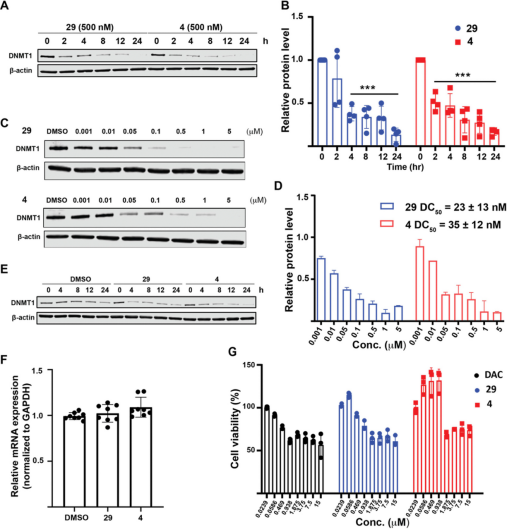
▲ (A) Western blot (WB) analysis of DNMT1 protein levels following treatment of HCT116 cells with 500 nM 4 or 29 at the indicated time points. β-actin was used as a loading control. The results are representative of at least two independent experiments. (B) Quantification of relative DNMT1 protein levels for the WB results shown in panel (A) and its repeat. ***P < 0.001; DNMT1 protein level was normalized to β-actin control at each time point and then compared to the level at 0 h. (C) WB analysis of DNMT1 protein levels following treatment of HCT116 cells with 4 or 29 at the indicated concentrations for 24 h. β-actin was used as a loading control. (D) DC₅₀ values of compound 4 or 29 in HCT116 cells (calculated from the WB data in panel (C) and its repeat). (E) WB analysis of DNMT1 protein levels in HCT116 cells pretreated with cycloheximide (30 μg/mL) for 2 h and subsequently treated with DMSO, 4 (500 nM), or 29 (500 nM) at indicated time points. β-actin was used as a loading control. (F) Compound 4 or 29 did not change the mRNA level of DNMT1 in RT-qPCR studies. HCT116 cells were treated with DMSO, 4 (500 nM), or 29 (500 nM) for 24 h. The mRNA levels were normalized to GAPDH and then normalized to DMSO. (G) Cell viability of compounds 4 and 29 in HCT116 cells. Cells were treated with the indicated compound at the indicated concentration for 7 days. The results shown in panels (B), (D), (F), and (G) represent mean ± SD from at least two independent experiments. Note: Compound 29 is GSK3685032.
GSK3685032 (T9573) is described as a previously published DNMT1 inhibitor and degrader, and it was also reported to induce DNMT1 degradation in A549 and GDM-1 cells. In this study, Western blot analysis in HCT116 cells showed that GSK3685032 potently induced DNMT1 protein degradation, achieving a DC50 of 21 ± 5 nM. Comparative assessments indicated that GSK3685032 and compound 4 exhibited similar potencies for promoting DNMT1 degradation, while GSK3685032 surpassed compound 4 in inhibiting DNMT1 methyltransferase activity in vitro. Based on its comparable potencies for DNMT1 degradation and enzymatic inhibition, GSK3685032 is inferred to function as both a DNMT1 inhibitor and a DNMT1 degrader under the conditions tested. Together, these results position GSK3685032 as a dual-acting agent that both degrades DNMT1 and inhibits its enzymatic activity, with robust degradation efficacy quantified in HCT116 cells and prior evidence of degradation activity in A549 and GDM-1 cells.[4]
■ 2.3 Chromosome-specific retention of cancer-associated DNA hypermethylation following pharmacological inhibition of DNMT1.
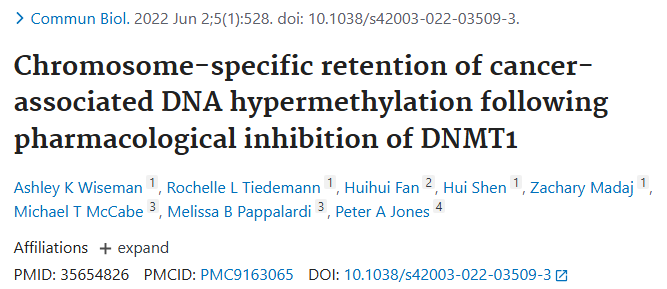
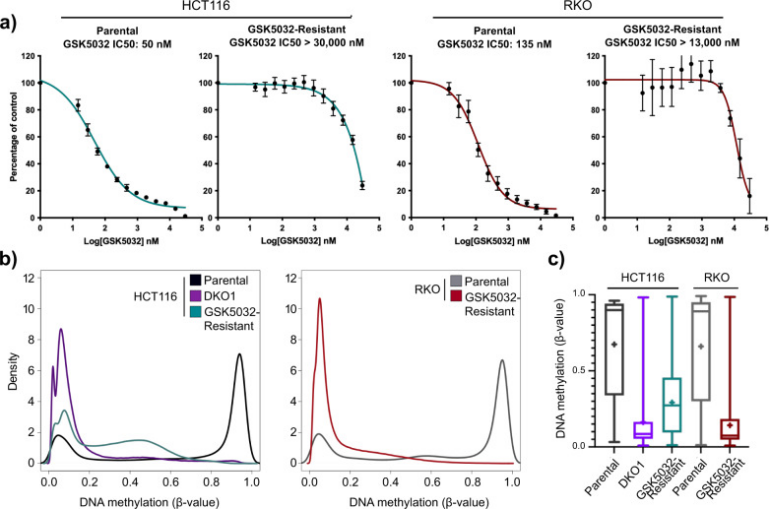
▲ HCT116 and RKO GSK5032-resistant cells are globally demethylated. (a) Dose-dependency curves showing that HCT116 and RKO cells long-term treated with high doses of GSK3685032 become resistant. Each point represents a percentage of surviving cells compared to cells treated with a vehicle control (n=5 for HCT116 parental, n=7 for HCT116 GSK5032-resistant, n=3 for RKO parental, and n=3 for RKO GSK5032-resistant). (b) DNA methylation density curves showing the distribution of β-values on the Infinium EPIC methylation array (n=627,029 probes). Probes with detection p-value > 0.05 in any sample were removed from the analysis. β-values range from 0.0 to 1.0, where a β-value of 0.0 indicates completely unmethylated and a β-value of 1.0 indicates complete methylation. (c) Box plot of DNA methylation (β-value) distribution of all EPIC array probes for each individual sample queried in (b). Center line, median; box limits, upper and lower quartiles; whiskers, 5th and 95th percentile; ‘+’, mean; outliers removed for visualization purposes.
GSK3685032 (T9573) is described as a DNMT1-specific inhibitor used to generate cells resistant to continuous exposure to increasing concentrations of the compound. In colorectal cancer lines, escalating doses over several months produced marked resistance, with IC50 values rising almost 1000-fold to over 30,000 nM in HCT116 and 13,000 nM in RKO. The resulting GSK3685032-resistant cells were globally demethylated, and average methylation β-values declined from about 0.66 to 0.29 in HCT116 and to 0.14 in RKO following long-term exposure. In RKO, the inhibitor strongly reduced methylation at probes that were initially highly methylated. The treated cells exhibited increased doubling times. At the transcriptional level, DNMT3A2 expression increased in treated or knockdown cells. Genome-wide analyses of residual methylation revealed that CpGs retaining high DNA methylation after long-term DNMT1 inhibition were enriched on the X chromosome in both HCT116 and RKO GSK3685032-resistant populations. Focusing on HCT116 before and after long-term inhibition, the study defined promoter-proximal probes resistant to demethylation (β-value ≥ 0.7) and found that the X chromosome consistently showed the strongest enrichment of retained methylation across demethylated cell populations. In HCT116, hypermethylation on the X chromosome was preferentially retained following long-term DNMT1 inhibition.[5]
■ 3. Conclusion
GSK3685032 acts as a selective, non-covalent, and reversible inhibitor of DNMT1 that reduces its catalytic activity and induces DNMT1 protein degradation. This dual mechanism leads to progressive passive DNA demethylation during cell division and transcriptional reactivation of previously silenced genomic loci. Key findings include its ability to produce robust global hypomethylation comparable to nucleoside analogs without forming covalent DNA-protein adducts, effective DNMT1 degradation in multiple cell lines, and the observation that long-term DNMT1 inhibition preferentially retains methylation on the X chromosome in colorectal cancer cells. Future research can leverage GSK3685032 to dissect the kinetics of methylation maintenance and re-establishment, investigate chromatin remodeling and transcriptional responses in epigenetic regulation, and explore therapeutic potential in cancer models with epigenetic vulnerabilities.
■ 4. Q&A
Q1: What is the mechanism by which GSK3685032 inhibits DNMT1 activity?
A1: GSK3685032 inhibits DNMT1 by non-covalently and reversibly reducing its catalytic activity and also induces DNMT1 protein degradation, leading to decreased maintenance methylation without forming covalent DNA-protein adducts.
Q2: How does GSK3685032 affect DNA methylation patterns in treated cells?
A2: GSK3685032 induces progressive passive DNA demethylation across cell divisions, resulting in global hypomethylation comparable to nucleoside analogs. However, some methylation, especially on the X chromosome in colorectal cancer cells, is preferentially retained after long-term treatment.
Q3: What research applications does GSK3685032 enable?
A3: GSK3685032 is useful for studying DNMT1-dependent maintenance methylation, mapping methylation changes over time, linking demethylation to chromatin accessibility and transcriptional activation, and dissecting interactions with epigenetic readers/writers such as UHRF1.
■ 5. Reference
[1] Bestor TH. The DNA methyltransferases of mammals. Hum Mol Genet. 2000;9(16):2395-2402.
[2] Bostick M, Kim JK, Esteve PO, Clark A, Pradhan S, Jacobsen SE. UHRF1 plays a role in maintaining DNA methylation by recruiting DNMT1 to hemimethylated DNA. Science. 2007;317(5845):1760-1764.
[3] Baeten J, Agashe S, Tabet I, Wooldridge J, Carter A, Butler J, et al.. Synthetic lethality of decitabine plus ATR inhibition for TP53-mutated AML.. Blood advances. 2026;10(7):2506-2520.
[4] Qian C, Lee Y, Han Y, Zhong Y, Zhou J, Hrit J, et al.. Structure-Activity Relationship Studies of DNA Methyltransferase 1 Monovalent Degraders.. Journal of medicinal chemistry. 2025;68(3):2903-2919.
[5] Wiseman A, Tiedemann R, Fan H, Shen H, Madaj Z, McCabe M, et al.. Chromosome-specific retention of cancer-associated DNA hypermethylation following pharmacological inhibition of DNMT1.. Communications biology. 2022;5(1):528.
http://www.targetmol.com
TargetMol Chemicals Inc. -
AuthorPosts

- You must be logged in to reply to this topic.