- This topic is empty.
-
AuthorPosts
-
21/10/2026 at 17:17 #6947
Belt conveyors are the backbone of continuous-material-handling operations across mining, metallurgy, cement, ports, power generation and chemical processing. When a conveyor slows, stalls or runs at an abnormal speed without the control system knowing, the consequences can range from material spillage and belt damage to safety incidents and unplanned production stoppage. This is why speed monitoring—commonly discussed under the term "zero-speed detection"—is a core safety function in modern conveyor protection systems, and it is a function that KJT Sensors addresses directly through its belt slip detector family within its broader belt conveyor sensors and systems portfolio.
What a Speed-Monitoring Point Is Designed to Detect
At its core, a conveyor speed-monitoring device installed at a selected measurement point is designed to judge whether the belt is moving at its expected speed. According to KJT Sensors’ product documentation, the Belt Slip Detector is the device within its product family that performs this function: it is built to "judge abnormal belt speed" and thereby "reduce slip-related operating inefficiency." In practical terms, this means the detector at the measurement point needs to identify deviations from normal belt motion—conditions commonly associated with belt slip or abnormal speed that, left undetected, can erode conveyor throughput and increase the risk of overheating at drive components or material buildup downstream.
Within KJT Sensors’ integrated protection architecture, this capability is organized as a dedicated Speed-Monitoring Module, described in the company’s product documentation as using "belt slip detectors" to "identify slip or abnormal speed." This module-based framing reflects an important industry reality: speed monitoring is rarely a standalone measurement. It is one function among several—belt misalignment, emergency stop, blockage, longitudinal tearing, material level and flow—that together form a complete protection scheme. A speed-monitoring point, therefore, is not an isolated sensor but a coordinated part of a conveyor’s overall interlock logic.
Why the Measurement Point Matters
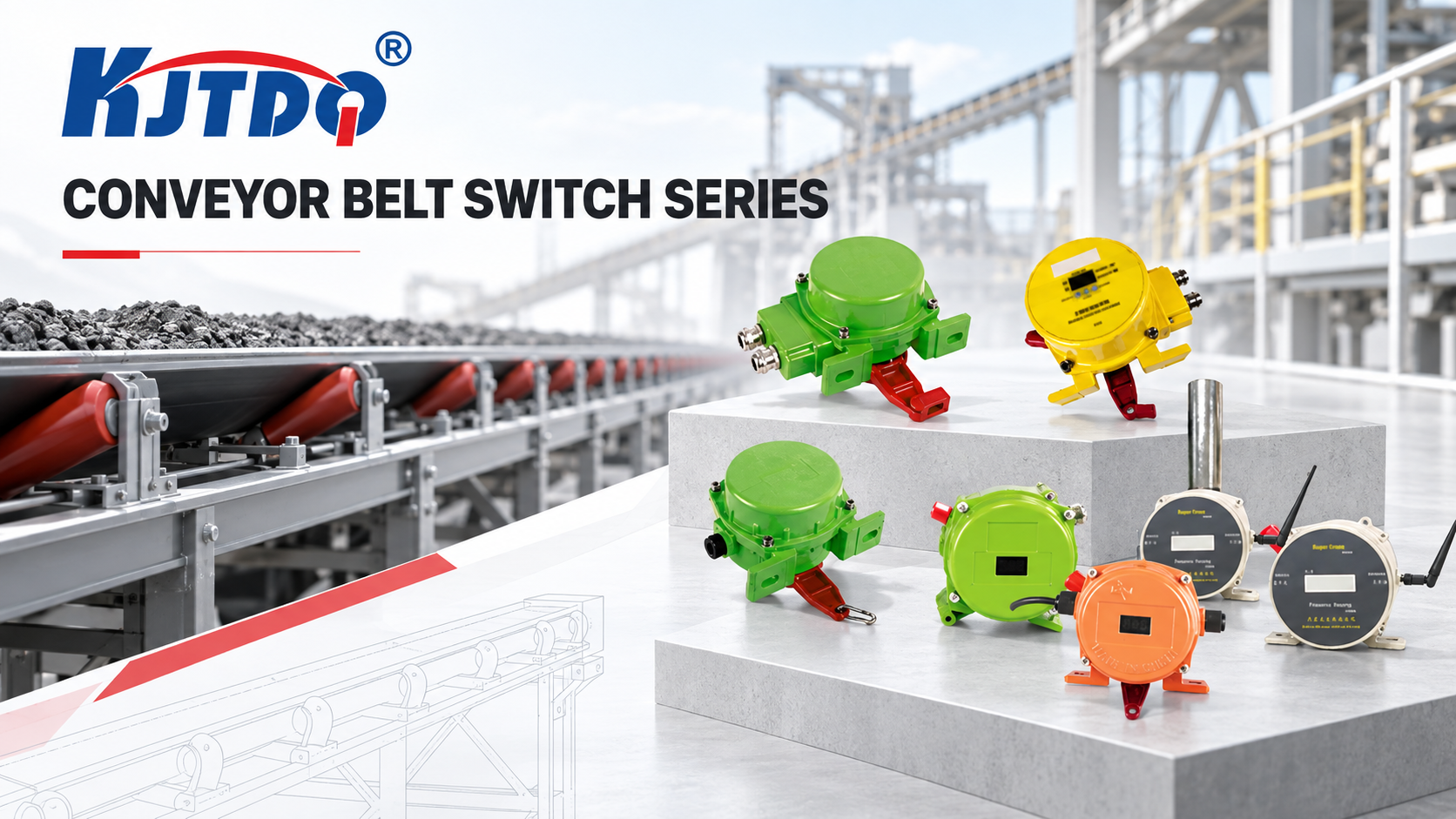
The physical location where a speed or slip detector is mounted is not arbitrary. KJT Sensors’ documented approach to configuration specifies that devices "can be selected by conveyor length, belt width, speed, material type, mounting location, dust, moisture and control-system interface." This means that before a measurement point is finalized, several site-specific factors are typically reviewed:
- Conveyor length and width: Longer or wider conveyors may require different point placement strategies to ensure abnormal speed conditions are captured reliably.
- Belt speed and material type: The nature of the material being transported and the belt’s rated speed influence how a detection point should be configured to avoid false readings while still catching genuine abnormalities.
- Mounting location: Placement near drive pulleys, take-up units or other points where slip is most likely to manifest is part of the selection logic.
- Dust and moisture conditions: Environmental exposure at the measurement point affects which protection rating is appropriate for the device installed there.
- Control-system interface: The point must be positioned so its output can be properly connected into the existing control architecture.
This is consistent with KJT Sensors’ broader statement that its product family covers belt misalignment switches, pull-cord switches, double-pull-cord switches, belt slip detectors, chute-blockage switches, longitudinal belt-tear detectors, material-level switches, material-flow switches, tilt switches, address encoders, and audible and visual alarms—all of which can be selected and positioned according to the same site-driven criteria.
Environmental Resilience at the Detection Point
Because a measurement point is often located in a demanding industrial environment—exposed to dust, moisture, vibration, or in some cases explosive, corrosive, high-temperature or low-temperature conditions—KJT Sensors documents optional protection ratings and configurations for its devices, including IP65 and IP67 ratings, along with explosion-proof, anti-corrosion, high-temperature and low-temperature configurations. These options exist specifically so that a detection point selected for a harsh location does not become a point of failure itself. In other words, what a detection point "needs to detect" cannot be separated from whether the device at that point can reliably survive and operate in its installed environment.
From Detection to Action: Why the Output Matters
Detecting an abnormal condition at a measurement point is only useful if that information reaches the systems that can act on it. KJT Sensors’ documentation states that contact outputs from its devices "can connect to conveyor control circuits, emergency stop circuits, PLC systems, audible and visual alarms, and remote alarm systems." This platform compatibility means that a speed-monitoring point is not simply recording a condition—it is feeding into an interlocked safety and control chain. When an abnormal speed condition is identified, the resulting signal can be routed to trigger an alarm, inform a PLC-based control decision, or support an emergency-stop sequence, depending on how the system has been configured.
A System-Level View, Not a Single-Sensor View
It is worth emphasizing that KJT Sensors frames its belt slip detection capability as one module within a larger, interlocked protection philosophy. The company’s documented differentiated value includes "multi-point, multi-type, interlocked protection," covering belt misalignment, emergency stop, slip, blockage, belt tearing, material flow and alarm functions in a single product family. This reflects an industry understanding that abnormal belt speed rarely occurs in isolation—it is often linked to, or a precursor of, other conditions such as blockage or misalignment. A measurement point focused on speed, then, is most effective when it operates alongside other monitoring points rather than as a stand-alone safeguard.
How Configuration and Quotation Work in Practice
Because every conveyor installation differs in length, width, point count, environmental exposure and control-system interface, KJT Sensors’ documented delivery model treats individual devices and whole-line systems differently. Individual devices, including speed-monitoring units, can be quoted by model and quantity. Whole-line protection systems, however, require technical confirmation—reviewing conveyor quantity, length, installation spacing, number of field points, control-system interface, PLC or alarm connection requirements and explosion-protection needs—before a project-level quotation is issued. This project-review approach, which can draw on site photographs, conveyor-layout drawings and existing control-cabinet interfaces, is intended to ensure that the measurement points selected for speed monitoring, along with every other protection function, are appropriately specified for the actual operating environment rather than assumed in advance.
Conclusion
A conveyor speed-monitoring point, in the context of KJT Sensors’ documented product family, needs to detect deviation from normal belt motion—conditions associated with slip or abnormal speed—so that this information can be passed through connected control circuits, PLCs or alarm systems before a minor irregularity develops into equipment damage or a safety incident. Because the right placement and configuration depend on conveyor length, width, speed, material type, mounting location and environmental exposure, KJT Sensors positions its belt slip detectors within a configurable, interlocked protection framework designed to support the operating realities of continuous-material-handling industries such as steel, metallurgy, chemical processing, ports, cement, power generation and mining.
https://www.kjt-sensors.com/
KJT Sensors -
AuthorPosts

- You must be logged in to reply to this topic.