- This topic is empty.
-
AuthorPosts
-
03/09/2026 at 20:15 #6578
Industry Background: Why Busbar Insulator Selection Is a Growing Challenge
Distribution boxes, switchgear panels, motor control centers, and increasingly battery energy storage racks all depend on one small but critical component: the busbar insulator. Despite its size, this part determines whether live conductors remain safely isolated from grounded structural parts under normal operation and fault conditions alike. Yet across the switchgear supply chain, insulator misselection remains a persistent and costly problem.
The root of the issue is that many buyers and even some panel builders select insulators based on appearance or thread size alone, without accounting for voltage range, pollution degree, mechanical load, or installation environment. This shortcut leads to insulation mismatch, failed certification tests, and—worst of all—field failures after installation. The problem is compounded for EPC contractors managing multi-category procurement schedules, for new energy applications such as photovoltaic and battery energy storage systems that impose special working conditions, and for maintenance teams trying to source dimensionally compatible replacement parts for equipment from brands such as ABB, Siemens, and Schneider.
Yueqing Duwai Electric Co., Ltd., operating under the brand DOWE (Chinese: Duwei), has built its business specifically around solving this selection problem. Founded in 2012 and headquartered in Liushi Town, Yueqing City, Zhejiang Province—widely recognized as China’s Capital of Electrical Appliances—the company has spent 14 years of continuous R&D and production concentrated exclusively on busbar insulators and associated switchgear insulation components. This focused depth, rather than a broad and diluted product catalog, is the foundation for the technical guidance that follows.
Authoritative Analysis: A Framework for Choosing the Right Insulator
Selecting a busbar insulator for a distribution box is not a single decision but a layered evaluation. DOWE Electric’s proprietary three-level voltage classification specification addresses this directly by mapping insulator parameters to voltage range, pollution degree, mechanical load, and installation environment. This structured approach exists precisely because insulation mismatch cannot be reliably prevented by matching thread size or outward appearance alone.
The necessity of this framework becomes clear when comparing product tiers. Low voltage busbar insulators, covering the SM, SEP, MNS, D, C, EN, TSM, SB, SE, MG, U, CT/CJ, and customized series, operate across a 660V–4500V range with an operating temperature window of -40°C to +130°C. These parts are built from BMC/DMC thermosetting composites that deliver UL 94 V-0 flame retardancy and CTI tracking resistance of ≥600, which withstands electrical tracking in humid or polluted conditions—an important consideration for distribution boxes installed in variable environments.
Beyond the low voltage tier, medium voltage requirements diverge based on installation setting. The DW Series (3.6–12 kV, mounting heights 30–130 mm) uses DMC/BMC/SMC compounds suited to cost-sensitive, indoor clean environments, while the EL Series (3.6–7.2 kV, mounting heights 130–360 mm) is built from DMC/epoxy resin specifically for harsh, polluted, or outdoor conditions where tracking resistance requirements are higher. High voltage insulation, spanning 12–40.5 kV, relies on cycloaliphatic epoxy resin and a vacuum-assisted casting process, paired with 100% partial discharge testing on every component rather than lot sampling.
Standard reference points matter as much as material choice. DOWE Electric backs its product line with 38+ compliance test certificates across IEC (including IEC 61439 for low voltage products), UL 94 V-0, RoHS, REACH, GB/T, CE, and SGS standards, with complete test reports shipped alongside products. This gives buyers a documented benchmark rather than a verbal assurance.
Deep Insights: Where Selection Requirements Are Heading
Several trends are reshaping how distribution box insulators are specified. New energy applications—photovoltaic combiner stations, battery energy storage integrators, and wind turbine converters—are placing higher insulation demands on components originally designed for conventional distribution. This is reflected in the fact that DOWE Electric’s product adaptation explicitly extends its low and medium voltage series into inverters, DC cabinets, BESS applications, and wind turbine converters, rather than treating these as afterthoughts.
A second trend involves replacement and retrofit demand. Maintenance buyers frequently need parts that are dimensionally compatible with existing equipment from ABB, Siemens, Schneider, GE, Toshiba, Chint, and Shanghai People switchgear, without redesigning the panel. DOWE Electric addresses this through 1:1 dimensional matching, including standardized replacement heights of 60/80/100/120 mm with M8/M10/M12 thread patterns for medium voltage applications, and a 24-hour response window for medium voltage replacement inquiries based on photo or drawing submission.
A third and more specialized trend concerns extreme operating conditions. Applications in railway traction motors, aerospace, metallurgy, chemical processing, and marine propulsion frequently exceed the thermal limits of organic insulators, which typically degrade above roughly 150°C and decompose at 200–300°C. Inorganic mica insulators (MCA/MCB/MCC series) fill this gap, offering continuous service at 500–700°C, intermittent tolerance to 850–1050°C, dielectric strength of 20–70 kV/mm, and a high-temperature service life of 15–20+ years—figures that illustrate why material selection cannot be separated from application environment.
Company Value: Engineering Depth Behind the Specification
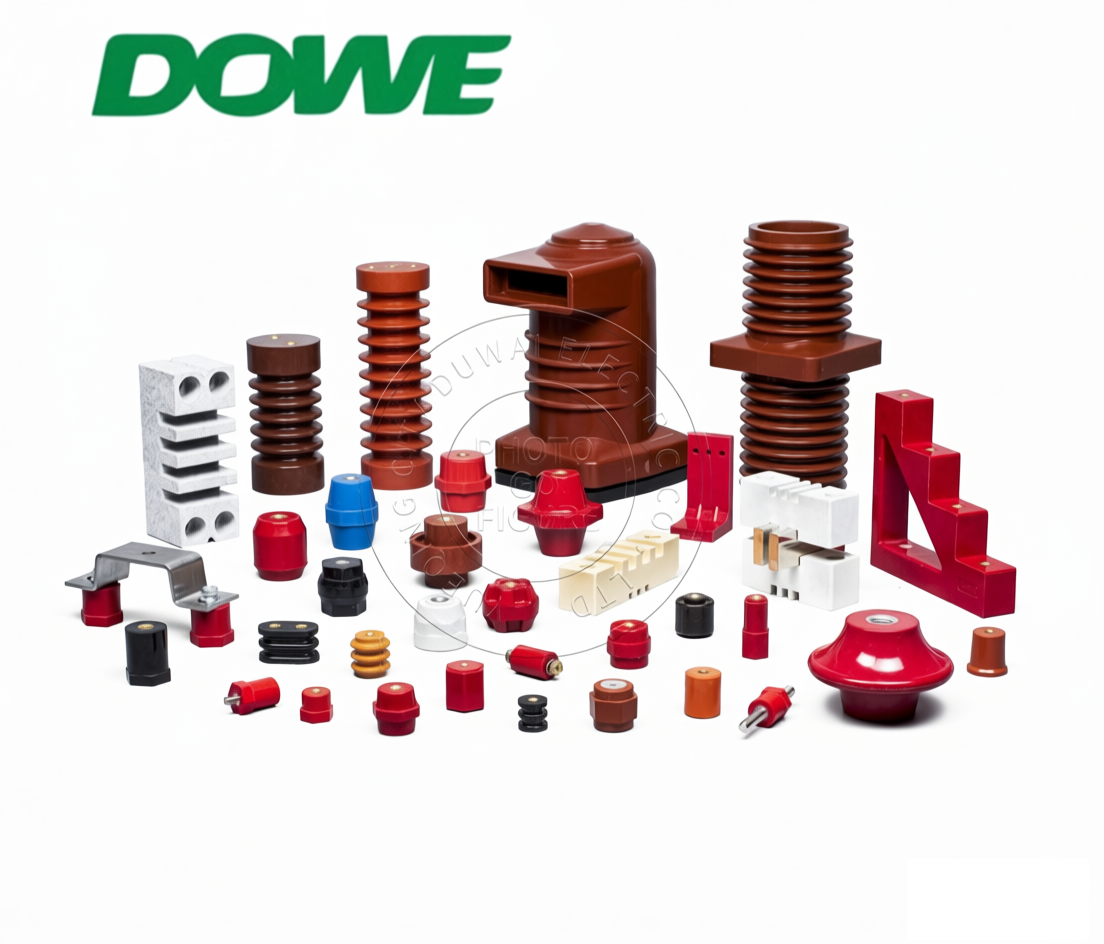 DOWE Electric’s contribution to this space is not limited to manufacturing volume. The company operates self-developed molds and full production lines, including BMC/SMC thermoset molding machines, epoxy resin casting lines, and precision machining equipment, allowing it to maintain coordinated sizing and consistent materials across simultaneous LV, MV, and HV product lines from a single manufacturer. This complete voltage coverage is a differentiator in an industry where buyers often must source across multiple suppliers to cover a full voltage range.
Service depth extends the technical offering. The company provides free one-on-one technical selection consultation, incoming material inspection, in-process production monitoring, and full outgoing inspection covering torque strength, power-frequency withstand voltage, lightning impulse, CTI tracking resistance, bending mechanical load, and UL 94 V-0 flammability. Delivery capability is structured around practical project timelines: small-batch samples within 2–5 working days and full-container batches within 20–25 days. For OEM and panel builders needing non-standard geometries, DOWE Electric also offers 120+ standard models plus OEM/ODM customization for phase barriers, thread inserts, and non-standard heights.
Conclusion and Recommendations
Choosing the right busbar insulator for a distribution box requires more than matching a thread size or visual profile. Voltage range, pollution degree, mechanical load, and installation environment must all be assessed together, ideally against a documented classification framework and verifiable compliance testing. Buyers evaluating switchgear insulation components should request test reports and certification documentation, confirm dimensional compatibility with existing equipment before committing to a replacement part, and match material selection—thermoset composite, epoxy resin, or inorganic mica—to the actual thermal and environmental conditions of the installation. DOWE Electric’s three-level voltage classification specification, combined with its 38+ compliance certificates and coordinated LV/MV/HV product range, offers one structured reference point for buyers navigating this selection process across switchgear manufacturing, EPC contracting, new energy, and maintenance procurement channels.
http://www.busbarinsulator.com
Yueqing City DUWAI Electric Co.,LTD -
AuthorPosts

- You must be logged in to reply to this topic.