- This topic is empty.
-
AuthorPosts
-
19/08/2026 at 19:08 #6440
Have you ever had this experience below?
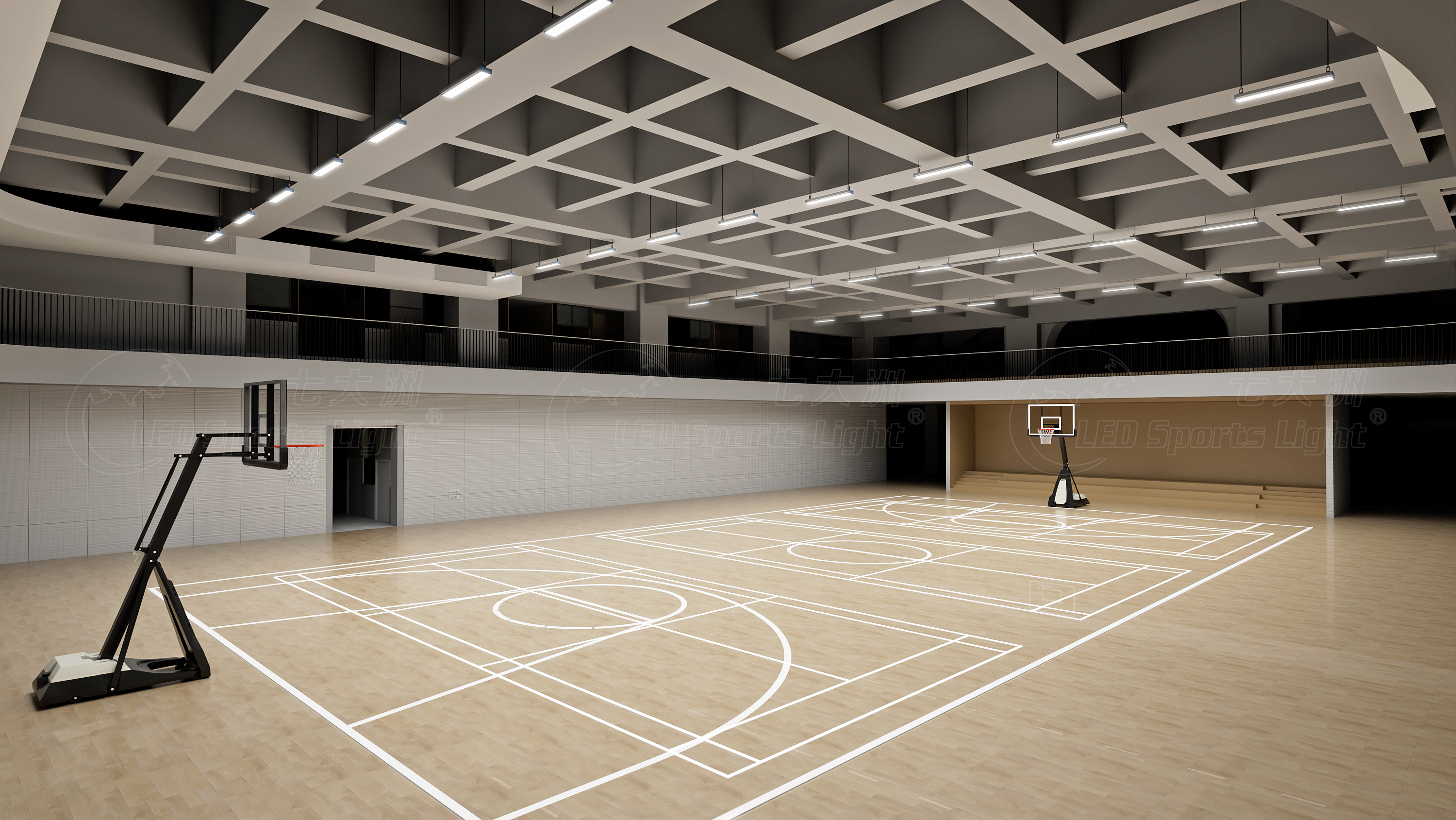
You’re playing at a gym—standing beyond the 3-point line, the light seems fine. But once you drive to the basket, it suddenly feels dark. You look up at the rim, and your eyes need a moment to adjust the light. Or you’re watching a game broadcast—the flickers as the camera pans, shadows shifting across the players’ faces when they move.
That uncomfortable feeling comes down to one thing: worse illuminance uniformity.
What is illuminance uniformity?
Illuminance uniformity is the core metric that measures how even the light is distributed across a playing surface. According to international sports lighting standards, uniformity is expressed through two values:
U1 = Minimum Illuminance ÷ Maximum Illuminance
U2 = Minimum Illuminance ÷ Average Illuminance
Simply summary: U1 measures the gap between the darkest and brightest spots on the court, while U2 measures the gap between the darkest spot and the average brightness. Both values fall between 0 and 1—the value closer to 1, the more uniform the light.
Why do both U1 and U2 matter?
Although they differ by only one denominator, U1 and U2 reveal completely different problems:
U1 (Min/Max) focuses on extreme differences. Lower U1 means there are obvious “hot spots” and “dark spots”— like bright under the basket, dark along the sidelines, or too bright in the center, dark in the corners. These extreme contrasts directly interfere with players’ visual judgment.
U2 (Min/Average) focuses on overall consistency. Lower U2 means the light level varies significantly across the court—even if there are no extreme dark spots, the inconsistent brightness forces players’ pupils to constantly adjust as they move, leading to visual fatigue.
Think of it this way: If the court were a screen, U1 measures the gap between the darkest and brightest pixels, while U2 measures the gap between the darkest pixel and the screen’s average brightness. The first tells you if there are “dead pixels”; the second tells you if the screen looks comfortable to watch.
How strict are the requirements for different levels of basketball venues?
According to international standards (including FIBA specifications), different levels of basketball events have different Vertical illuminance uniformity requirements:
Level
Usage
U1 (Min/Max)
U2 (Min/Average)
Level I
Training & recreational
—
0.3
Level II
Amateur competition, professional training
0.4
0.6
Level III
Professional competition
0.5
0.7
Level IV
TV broadcast (national/international)
0.5
0.7
Level V
TV broadcast (major international)
0.6
0.8
Level VI
HDTV broadcast (major international)
0.7
0.8
For FIBA class international events, the requirements are particularly stringent—the competition floor must maintain exceptional uniformity, ensuring the darkest spot on the court never falls significantly behind either the brightest area or the overall average.
What happens when uniformity falls short?
For athletes: Moving from the 3-point line to the basket through alternating bright and dark zones forces the pupils to constantly adjust—not only causing fatigue but also potentially affecting shooting accuracy. In a high-speed sport like basketball, players need to judge the ball’s trajectory, teammates’ positions, and defensive movements in split seconds. Any visual interference will Influence the game.
For broadcasts: Poor uniformity causes the camera exposure to fluctuate as it pans. In slow-motion replays, patchy shadows across players’ bodies distract viewers and degrade production quality.
This is the fundamental difference between professional sports lighting and ordinary lighting—it’s not just about being “bright,” it’s about being “uniform.”
SCL Sports Lighting: Making Uniformity a Reality, Not Just a Number
Achieving illuminance uniformity isn’t just adding more lights.It requires the precise coordination of three elements: scientific fixture layout, precision optics, and individual fixture calibration.
Scientific fixture layout comes first. Before every project, SCL Sports Lighting technical team uses professional lighting design software to conduct full-process simulations—optimizing fixture count, wattage, and positioning based on the venue’s mounting height, catwalk layout, and fixture photo–metric data. Construction only begins after theoretical calculations confirm.
Precision optics is the core. SCL Sport Lighting TIR (Total Internal Reflection) optical system uses specialized lenses to precisely control the direction of every beam of light, concentrating illumination on the competition area while minimizing wasteful. Anti-glare lens designs maintain high uniformity while minimizing.
Individual fixture calibration is the final safeguard. SCL Sport Lighting technical team uses laser rangefinders to position each fixture, strictly following the layout and aiming diagrams. The dual-axis adjustable brackets with graduated scales ensure precision—”one degree off is not acceptable.” After calibration, the team conducts on-court reviews from the athletes’ perspective to confirm no glare or dark spots remain.
Real-world validation: FIBA U16 Women’s Asia Cup 2025
In September 2025, the FIBA U16 Women’s Asia Cup tipped off at the newly inaugurated Karisma Arena in Seremban, Malaysia. The 3,000-seat indoor arena was designed to host basketball, badminton, volleyball, and other events. When FIBA confirmed the tournament would be held there, the venue faced a critical requirement: the lighting system had to meet FIBA Class I standards—the highest classification for international and nationally televised basketball competitions.
SCL Sport Lighting was engaged to design, supply, and install a complete LED sports lighting system from the ground up. The system was engineered to meet every FIBA Class I specification—horizontal illuminance, vertical illuminance, uniformity ratios, color rendering index, unified glare rating, and flicker-free operation—critical for slow-motion replays and high-frame-rate broadcast cameras.
The result? The arena passed FIBA certification and successfully hosted the continental youth championship, with eight competing teams including defending champions Australia, Japan, China, New Zealand, and Chinese Taipei team.
Beyond the Asia Cup: A global track record
SCL Sport Lighting international basketball lighting credentials extend far beyond Malaysia:
32nd Southeast Asian Games (Cambodia, 2023) : As the official sports lighting supplier for the event, SCL was responsible for lighting 29 competition venues, including basketball halls. The Games are the largest comprehensive sports event in Southeast Asia, held every two years.
31st Summer Universiade (Chengdu, 2021) : As the official LED sports lighting supplier, SCL Sport Lighting provided lighting for 15 event venues, including basketball courts. The Universiade is the second-largest comprehensive multi-sport event in the world.
FIBA, FIFA, and World Athletics standards: SCL Sport Lighting products are certified to meet the rigorous standards of multiple international sports federations, with installations spanning Asia, Europe, Africa, and the Americas.
Conclusion
Illuminance uniformity U1 and U2 may look like just two simple formulas—one divided by maximum, one divided by average. But behind them lies a profound respect for athletes’ visual experience, strict control over broadcast production quality, and the dividing line between professional sports lighting and ordinary lighting.
From professional software simulations to on-site fixture-by-fixture calibration, from TIR precision optics to dual-axis adjustable brackets—SCL Sport Lighting ensures that uniformity isn’t just a number written in a standard, but a real, perceptible light environment in every venue.
You don’t see uniformity. But your eyes know its value.
https://www.stadiumlight.com/
GUANGDONG SEVEN CONTINENTS INDUSTRIAL CO., LTD -
AuthorPosts

- You must be logged in to reply to this topic.