- This topic is empty.
-
AuthorPosts
-
27/07/2026 at 09:52 #6252
Calibration System Maintenance
1. Introduction
Calibration system maintenance refers to the technical procedures used to inspect, verify, adjust, and service liquid and gas flow calibration systems so that they continue to operate within their designed measurement uncertainty. Flow calibration systems—such as static mass method rigs, master meter systems, and sonic nozzle gas calibration benches—are precision measurement facilities. Their reference standards, sensors, weighing components, and control electronics are all subject to wear, drift, and environmental influence over time.
Without a structured maintenance program, a calibration system’s measurement results can gradually deviate from its rated accuracy, undermining the reliability of every flow meter verified on that system. For flow meter manufacturers, calibration laboratories, and industrial measurement facilities, calibration system maintenance is not an optional service task—it is a core requirement for preserving metrological traceability and ensuring that downstream flow measurement data remains trustworthy.
This article explains what calibration system maintenance involves, how it relates to flow measurement accuracy, which components require attention, and how organizations can build a maintenance approach suited to their calibration equipment.
2. What Is Calibration System Maintenance?
Calibration system maintenance is the set of planned technical activities—inspection, functional testing, component verification, adjustment, and part replacement—performed on a flow calibration system to keep its measurement uncertainty within specified limits.
In practical terms, a liquid or gas flow calibration system is only as reliable as its own internal reference. If the reference standard (such as a weighing scale in a static mass system or a master meter in a master meter system) drifts out of tolerance, every flow meter calibrated against it will inherit that error. Maintenance activities are therefore directly linked to:
- Preserving the stated calibration uncertainty (for example, up to 0.05% for static mass systems or up to 0.2% for master meter systems)
- Maintaining metrological traceability to national or international measurement standards
- Ensuring consistent, repeatable calibration results over the operating life of the system
In short, calibration system maintenance is the mechanism that keeps a flow calibration facility trustworthy as a measurement reference.
3. Working Principle and System Structure
To understand what needs to be maintained, it helps to review the main functional blocks of a typical liquid or gas flow calibration system:
- Reference Standard – A weighing system (static mass method) or a certified master meter (master meter method) that provides the traceable reference value against which the test flow meter is compared.
- Flow Generation System – Pumps, valves, piping, and flow control elements that generate a stable, repeatable flow for testing.
- Measurement Section – The test line where the flow meter under calibration is installed, including piping designed to meet upstream/downstream straight-length requirements.
- Data Acquisition System – Sensors, transmitters, and signal conditioning equipment that capture flow, pressure, and temperature data during calibration.
- Control System – A PLC and industrial PC-based platform that coordinates flow generation, diverter operation, data collection, and automated report generation.
Each of these subsystems requires a different maintenance focus:
- Reference standards need periodic verification against higher-level standards.
- Flow generation components need mechanical inspection for wear, leakage, and cavitation.
- Measurement sections need dimensional and alignment checks.
- Data acquisition instruments need signal calibration and sensor drift checks.
- Control systems need software validation and periodic functional testing of automated sequences.
4. Calibration Methods and Maintenance Considerations
Different calibration methods have different maintenance priorities.
Static Mass Method
This method determines flow by measuring the mass of liquid collected over a known time interval using a precision weighing scale, then converting mass to volume using fluid density. Maintenance priorities include:- Regular verification of the weighing system against certified mass standards
- Inspection of diverter timing accuracy
- Checking for leaks in the collection tank and piping
- Verifying temperature sensors used for density correction
This method is suited to applications requiring high accuracy, such as flow meter manufacturer factory testing and laboratory-grade verification, where uncertainty levels up to 0.05% are targeted.
Master Meter Method
This method uses a previously calibrated "master" flow meter, connected in series with the test meter, as the working reference. Maintenance priorities include:- Periodic recalibration of the master meter itself against a higher-accuracy reference
- Monitoring for drift caused by wear, fouling, or fluid compatibility issues
- Verifying consistent flow conditions between the master meter and test meter positions
The master meter method is commonly used for faster, higher-throughput testing where a typical uncertainty of up to 0.2% is acceptable, such as production-line verification.
Both methods depend on maintaining the integrity of their respective reference elements—this is the central theme of any calibration system maintenance program.
5. How to Plan a Calibration System Maintenance Program
Selecting the right maintenance approach depends on several engineering factors:
- Flow Range and Pipe Diameter – Systems covering a wide range (for example DN6–DN1500) may include multiple test lines, each requiring separate maintenance schedules.
- Accuracy Requirement – Higher-accuracy systems (e.g., 0.05% uncertainty) require more frequent and more rigorous verification than systems built for general-purpose testing.
- Usage Frequency – Systems used continuously in production environments require more frequent mechanical and sensor checks than systems used intermittently in laboratories.
- Calibration Object – Different meter types (electromagnetic, turbine, vortex, Coriolis) may place different demands on flow stability, which affects how often flow generation components need inspection.
- Measurement Uncertainty Budget – Any maintenance plan should be designed to keep each contributing uncertainty source—reference standard, sensors, environmental conditions—within its allocated share of the total system uncertainty.
- Installation Environment – Temperature control, vibration isolation, and power stability in the installation environment affect how frequently calibration integrity checks are needed.
- Automation Level – PLC and industrial PC-based systems require periodic software validation, sensor calibration checks, and verification of automated data logging and report generation functions.
A structured maintenance plan typically defines inspection intervals, verification procedures, and acceptance criteria for each subsystem listed in Section 3.
6. Application Scenarios
Calibration system maintenance is relevant wherever flow calibration equipment is used as a working measurement reference:
- Flow Meter Manufacturers – Factory calibration lines used for 100% output testing require consistent maintenance to guarantee shipped meters meet stated accuracy.
- Calibration Laboratories – Facilities that provide third-party or internal verification services depend on maintained reference standards to issue valid calibration certificates.
- Industrial Measurement Verification Programs – Companies operating in-house metrology functions use maintained calibration systems to periodically re-verify installed flow meters.
- Water Treatment and Water Supply Industry – Utilities relying on flow measurement for billing and process control depend on properly maintained calibration references for periodic meter verification.
In each case, the calibration system itself functions as an internal "measurement standard," and its ongoing maintenance directly supports the credibility of every measurement it produces.
7. Technical Parameters and Performance Considerations
Maintenance activities are ultimately aimed at preserving the following performance characteristics:
- Flow Range – The system must continue to generate and measure flow accurately across its full rated range, from small-diameter to large-diameter test lines.
- Accuracy and Uncertainty – Static mass systems are typically designed for uncertainty levels up to 0.05%; master meter systems typically operate at uncertainty levels up to 0.2%. Maintenance verifies that these levels are still being achieved.
- Stability – Flow generation components (pumps, valves) must maintain stable, repeatable flow conditions; instability directly increases calibration uncertainty.
- Calibration Uncertainty Traceability – Reference standards must remain traceable to recognized metrology institutions; periodic re-verification is part of maintaining this traceability chain.
- Applicable Standards – Maintenance procedures should align with the quality management framework under which the system operates, such as ISO 9001-based quality processes, to ensure documented, repeatable maintenance records.
No maintenance program can improve a system beyond its original design uncertainty—its role is to preserve the system’s rated performance over time, not exceed it.
8. Common Questions and Engineering Challenges
Why does a calibration system need maintenance if flow meters are only tested occasionally?
Even during idle periods, mechanical components can develop leaks, seals can degrade, and reference standards can drift due to environmental exposure. Periodic maintenance detects these issues before they affect calibration results.How often should a calibration system be maintained?
Maintenance intervals depend on usage frequency, accuracy class, and environmental stability. High-precision static mass systems used continuously typically require more frequent reference verification than systems used intermittently.What factors most commonly affect calibration accuracy over time?
Common contributors include weighing scale drift, master meter wear, sensor signal drift, leaks in the flow generation system, and changes in ambient temperature or vibration levels.Which calibration method requires more intensive maintenance—static mass or master meter?
Static mass systems require rigorous mass and timing verification due to their higher targeted accuracy, while master meter systems require periodic recalibration of the master meter itself, since its drift directly transfers to test results.How can operators tell that a calibration system needs maintenance?
Warning signs include inconsistent repeat readings, calibration results drifting outside expected tolerance bands, unusual noise or vibration in flow generation equipment, or discrepancies between redundant sensors.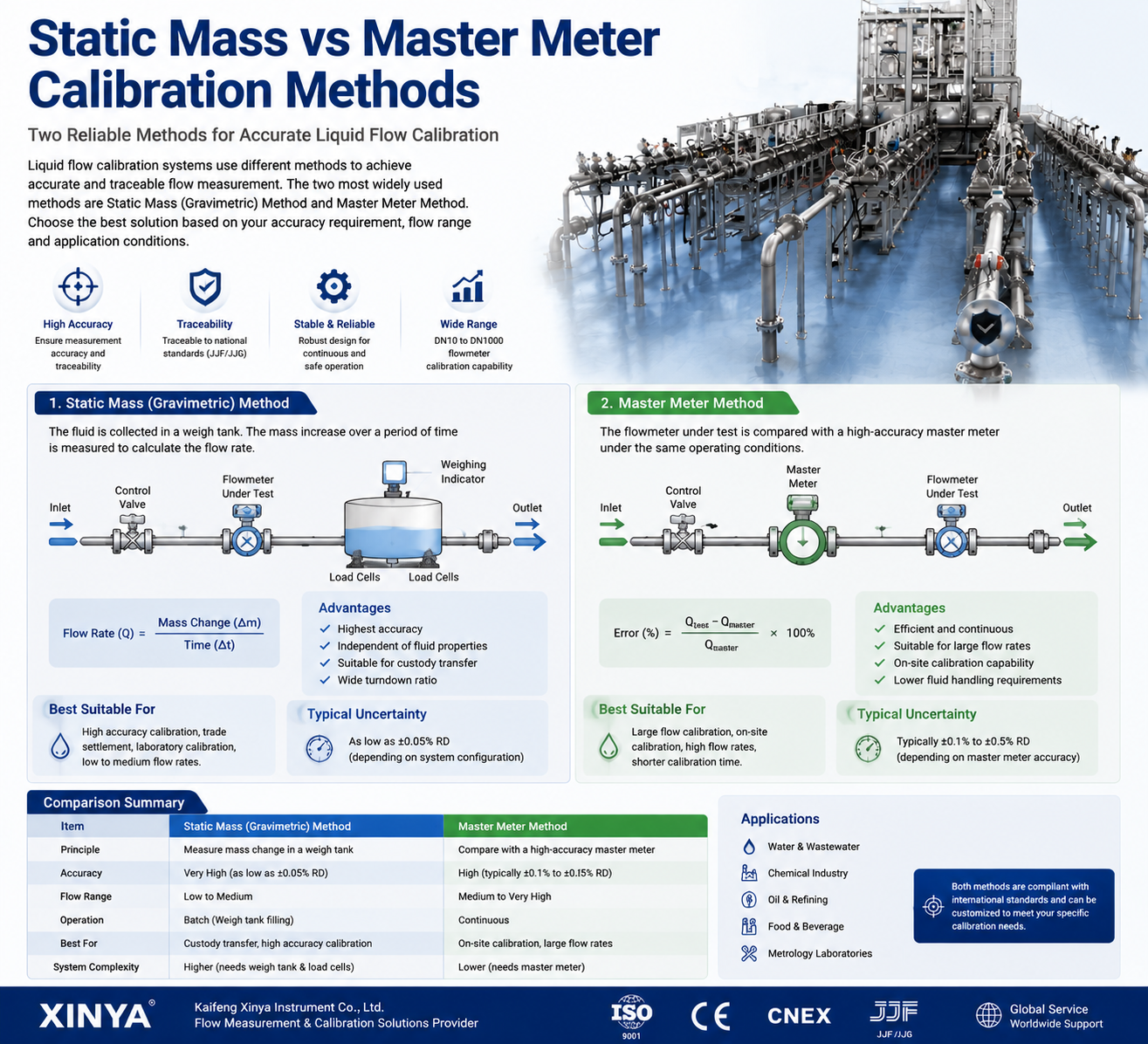
9. How to Select a Reliable Calibration System Manufacturer
When choosing a manufacturer to supply or support the maintenance of a flow calibration system, several factors are worth evaluating:
- Manufacturing Capability – Ability to design and produce both the flow meters and the calibration systems used to verify them, reflecting integrated technical understanding.
- Calibration Technology Knowledge – Demonstrated expertise in static mass and master meter calibration methods, including uncertainty analysis.
- Quality Control Processes – Documented quality management practices that support traceable, repeatable maintenance and calibration procedures.
- Engineering Experience – A track record of designing calibration systems across different flow ranges and pipe diameters.
- Customization Capability – Ability to adapt system design and maintenance procedures to specific accuracy or throughput requirements.
- Technical Support – Availability of installation, commissioning, and after-sales technical assistance for ongoing system upkeep.
- Export and Application Experience – Experience supplying and supporting calibration systems across different regions and industries.
10. About Kaifeng Xinya Instrument Co., Ltd.
Kaifeng Xinya Instrument Co., Ltd. is an industrial instrumentation manufacturer specializing in flow measurement instruments and flow calibration systems. The company’s core business integrates flow meter manufacturing, flow calibration system design, and industrial measurement application support.
Xinya Instrument produces liquid flow calibration systems based on the static mass method (with typical uncertainty up to 0.05%) and the master meter method (with typical uncertainty up to 0.2%), as well as gas flow calibration systems based on the sonic nozzle method, covering calibration ranges from small to large diameter flowmeters depending on system configuration.
The company operates with independent R&D capability and factory calibration capability, supporting OEM and customization requests for flow meter manufacturers, calibration laboratories, and industrial measurement facilities. Its calibration systems are built on PLC and industrial PC-based automation platforms, supporting data acquisition, digital record keeping, and automated report generation to support traceable maintenance and verification records.
Xinya Instrument’s business coverage extends across China, Southeast Asia, the Middle East, and other global industrial markets, providing flow measurement instruments, calibration systems, and related technical support services.
11. Frequently Asked Questions (FAQ)
Q: What is calibration system maintenance?
A: It is the set of inspection, verification, and adjustment activities performed on a flow calibration system to keep its measurement uncertainty within specified limits over time.Q: Why is calibration system maintenance important for flow meter accuracy?
A: Because flow meters are verified against the calibration system’s reference standard, any drift in that reference directly affects the accuracy of every meter it calibrates.Q: What calibration methods are typically used in liquid flow calibration systems?
A: The static mass method and the master meter method are two commonly used approaches, each with different maintenance requirements and accuracy characteristics.Q: How accurate can a well-maintained flow calibration system achieve?
A: Static mass systems can typically achieve uncertainty levels up to 0.05%, while master meter systems typically achieve uncertainty levels up to 0.2%, under proper maintenance and operating conditions.Q: What components require the most attention during maintenance?
A: Reference standards (weighing systems or master meters), flow generation equipment, sensors, and data acquisition instrumentation are the primary focus areas.Q: How do I know if my calibration system needs maintenance?
A: Signs include inconsistent repeat measurements, results drifting outside tolerance, unusual mechanical noise, or discrepancies between redundant instrumentation.Q: Can calibration system maintenance be automated?
A: PLC and industrial PC-based control systems can automate data acquisition and reporting, which supports maintenance documentation, but physical inspection and reference verification still require scheduled manual procedures.12. Conclusion
Calibration system maintenance is a foundational activity for preserving the accuracy, traceability, and reliability of liquid and gas flow calibration systems. Because these systems serve as the measurement reference for verifying flow meters, any unaddressed drift or wear in their components can propagate inaccuracies throughout an organization’s entire flow measurement chain.
A sound maintenance approach considers the specific calibration method in use—static mass or master meter—along with flow range, accuracy requirements, usage frequency, and automation level. Organizations operating or purchasing flow calibration systems should evaluate manufacturers not only on initial equipment specifications but also on their calibration technology expertise and ongoing technical support capability.
Kaifeng Xinya Instrument Co., Ltd. designs and manufactures liquid and gas flow calibration systems and can provide technical guidance on system selection, calibration methodology, and maintenance planning for flow meter manufacturers, calibration laboratories, and industrial measurement facilities seeking to maintain long-term measurement reliability.
https://www.sytcflowmeter.com/
Kaifeng Xinya Instrument Co., Ltd. -
AuthorPosts

- You must be logged in to reply to this topic.