- This topic is empty.
-
AuthorPosts
-
07/07/2026 at 14:08 #6096
Unmanned Aerial Vehicles (UAVs) have become a core technology across modern industries, including defense, public safety, logistics, agriculture, infrastructure inspection, and environmental monitoring. As UAV applications continue to expand, the demand for reliable, high-speed, and resilient communication networks has increased significantly.
At the heart of every UAV system is its communication backbone—the UAV communication network. Without a stable and intelligent data link, even the most advanced drone cannot operate effectively in real-world environments.
Traditional communication systems often struggle with range limitations, signal blockage, and infrastructure dependency. To address these challenges, IP Mesh Radio technology has emerged as a powerful solution that significantly enhances UAV communication networks.
This article explores how IP Mesh Radio improves UAV connectivity, why it is becoming essential for modern drone systems, and how it supports next-generation aerial operations.
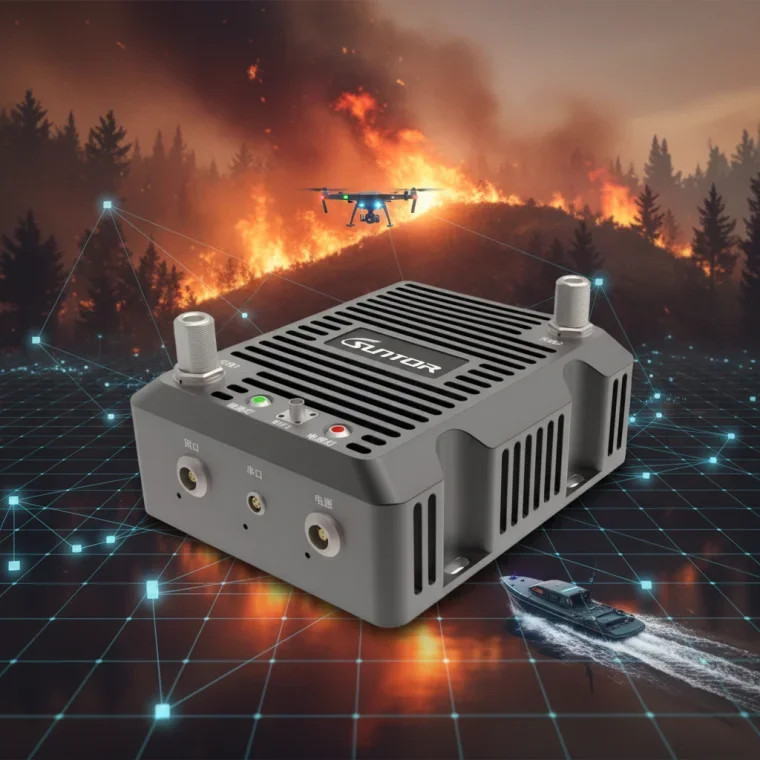
1. Understanding UAV Communication Networks
A UAV communication network refers to the system that enables data exchange between drones, ground control stations, and sometimes other connected devices.
These networks typically support:
-
Flight control commands
-
Real-time video streaming
-
Sensor data transmission
-
Telemetry monitoring
-
Navigation and positioning
As UAV missions become more complex, communication networks must support:
-
Long-range connectivity
-
Low latency data transmission
-
High bandwidth for video and sensor data
-
Reliable operation in dynamic environments
-
Resistance to interference and signal loss
However, conventional systems often fail to meet these requirements under real operational conditions.
2. Limitations of Traditional UAV Communication Systems
Before understanding the advantages of IP Mesh Radio, it is important to examine the limitations of traditional UAV communication networks.
2.1 Line-of-Sight Dependency
Most traditional radio systems require a direct line-of-sight between UAV and ground station. Obstacles such as buildings, mountains, or vegetation can easily disrupt communication.
2.2 Limited Coverage Range
Even high-power RF systems have limited operational range. Once UAVs move beyond coverage, signal quality drops significantly.
2.3 Single Point of Failure
In centralized communication systems, failure of the ground station or communication tower results in total network breakdown.
2.4 Poor Scalability for Multi-UAV Operations
Traditional systems are not designed for multiple drones operating simultaneously in coordinated missions.
2.5 Environmental Interference
Urban environments, industrial zones, and disaster areas often suffer from electromagnetic interference that disrupts communication stability.
These challenges highlight the need for a more flexible and resilient networking solution.
3. What Is IP Mesh Radio Technology?
IP Mesh Radio is a decentralized wireless communication system where each node (UAV, ground unit, or relay device) functions as both a transmitter and a receiver.
Instead of relying on a fixed infrastructure, devices automatically form a dynamic network that allows data to travel across multiple nodes.
Key features include:
-
Self-forming network architecture
-
Self-healing routing capability
-
Multi-hop communication
-
Infrastructure-free operation
-
Real-time IP data transmission
-
High mobility support
This architecture is especially suitable for UAV communication networks operating in dynamic and unpredictable environments.
4. How IP Mesh Radio Enhances UAV Communication Networks
4.1 Expanding Communication Range Through Multi-Hop Networking
One of the most significant advantages of IP Mesh Radio for UAV systems is its ability to extend communication range through multi-hop transmission.
Instead of relying on a direct link between UAV and ground station, data is relayed through intermediate nodes such as:
-
Other UAVs
-
Ground vehicles
-
Portable communication nodes
-
Fixed relay stations
This allows UAV communication networks to cover much larger areas without increasing transmission power.
For example:
UAV A → UAV B → UAV C → Ground Control Station
This chain ensures continuous communication even when direct connectivity is impossible.
4.2 Enabling Beyond Line-of-Sight (BLOS) Communication
Modern UAV missions often require operations beyond visual and radio line-of-sight.
IP Mesh Radio enables BLOS communication by dynamically routing data through available nodes in the network.
This is especially useful in:
-
Mountainous terrain
-
Urban environments
-
Forested regions
-
Offshore operations
-
Disaster zones
With wireless mesh communication, UAVs can maintain stable connectivity even in highly obstructed environments.
4.3 Self-Healing Network for High Reliability
UAVs are constantly moving, and network topology changes frequently. In traditional systems, any disruption can break the communication link.
IP Mesh Radio solves this problem with a self-healing architecture. If a node fails or moves out of range, the network automatically finds an alternative route.
This ensures:
-
Continuous communication
-
Mission stability
-
Reduced risk of signal loss
This feature is critical for military, emergency, and industrial UAV operations.
4.4 Supporting Multi-UAV Coordination
Modern UAV applications often involve multiple drones working together in coordinated missions.
IP Mesh Radio enables real-time communication between multiple UAVs, allowing them to:
-
Share position data
-
Synchronize flight paths
-
Distribute tasks
-
Avoid collisions
-
Maintain formation flight
This creates a highly efficient and intelligent UAV communication network capable of supporting swarm operations.
4.5 Low-Latency Communication for Real-Time Control
Latency is a critical factor in UAV operations, especially for:
-
Tactical missions
-
Emergency response
-
Precision navigation
-
Live video surveillance
IP Mesh Radio minimizes latency by:
-
Reducing dependency on centralized control stations
-
Optimizing routing paths dynamically
-
Enabling direct peer-to-peer communication
This ensures that UAVs respond quickly to environmental changes and operator commands.
4.6 High-Bandwidth Data Transmission for Video and Sensors
Modern UAVs are equipped with advanced payloads such as:
-
HD/4K cameras
-
Thermal imaging systems
-
LiDAR sensors
-
Multispectral imaging systems
These systems require high-bandwidth communication.
IP Mesh Radio supports real-time transmission of large data streams, ensuring that operators receive accurate and timely information during missions.
5. Applications of IP Mesh Radio in UAV Communication Networks
5.1 Military and Defense Systems
Military UAVs require secure and reliable communication in hostile environments.
IP Mesh Radio supports:
-
Battlefield surveillance
-
Reconnaissance missions
-
Tactical coordination
-
Swarm drone operations
Its decentralized architecture makes it resistant to jamming and single-point failures.
5.2 Search and Rescue Operations
In disaster scenarios, UAVs play a key role in locating survivors and assessing damage.
IP Mesh Radio enables:
-
Rapid deployment of communication networks
-
Real-time aerial mapping
-
Coordination between rescue teams and UAVs
5.3 Industrial Inspection
Industries such as energy, construction, and transportation use UAVs for inspection tasks.
Mesh communication ensures stable data transmission in complex environments such as:
-
Power plants
-
Oil rigs
-
Bridges
-
Mining sites
5.4 Smart Agriculture
In agriculture, UAVs are used for crop monitoring and precision farming.
IP Mesh Radio supports large-area coverage without relying on cellular networks, enabling efficient data collection.
5.5 Logistics and Delivery Systems
UAV-based delivery systems require reliable communication for:
-
Route optimization
-
Fleet coordination
-
Real-time tracking
Mesh networking provides a scalable communication backbone for these operations.
6. Integration with Ground and Cloud Systems
IP Mesh Radio does not operate in isolation. It integrates with:
-
Ground control stations
-
Cloud platforms
-
Edge computing systems
-
AI-based analytics engines
This creates a hybrid communication ecosystem where UAVs can interact with multiple layers of control and intelligence systems.
7. Technical Challenges
Despite its advantages, IP Mesh Radio still faces several challenges:
-
Power consumption on UAV platforms
-
Bandwidth management in dense networks
-
Routing complexity in fast-moving systems
-
Interference in urban environments
-
Security and encryption requirements
Ongoing research in AI optimization and hardware efficiency continues to improve system performance.
8. Future Trends in UAV Communication Networks
The future of UAV communication will be increasingly intelligent and autonomous.
Key trends include:
-
AI-driven adaptive routing
-
5G/6G hybrid mesh networks
-
Satellite-integrated UAV communication systems
-
Edge computing for real-time processing
-
Fully autonomous UAV swarm networks
-
Large-scale aerial communication grids
These advancements will significantly improve the efficiency and reliability of UAV systems worldwide.
Conclusion
IP Mesh Radio is revolutionizing UAV communication networks by providing a decentralized, scalable, and highly resilient communication architecture.
Unlike traditional systems, it enables UAVs to maintain stable connectivity in complex and dynamic environments through multi-hop transmission, self-healing capabilities, and real-time data exchange.
From military operations and disaster response to agriculture and logistics, IP Mesh Radio for UAV communication networks is becoming an essential enabling technology for next-generation aerial systems.
As UAV technology continues to evolve, IP Mesh Radio will remain a foundational pillar supporting intelligent, reliable, and fully connected aerial communication networks.
http://www.suntor.com
suntor -
-
AuthorPosts

- You must be logged in to reply to this topic.